




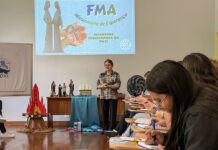



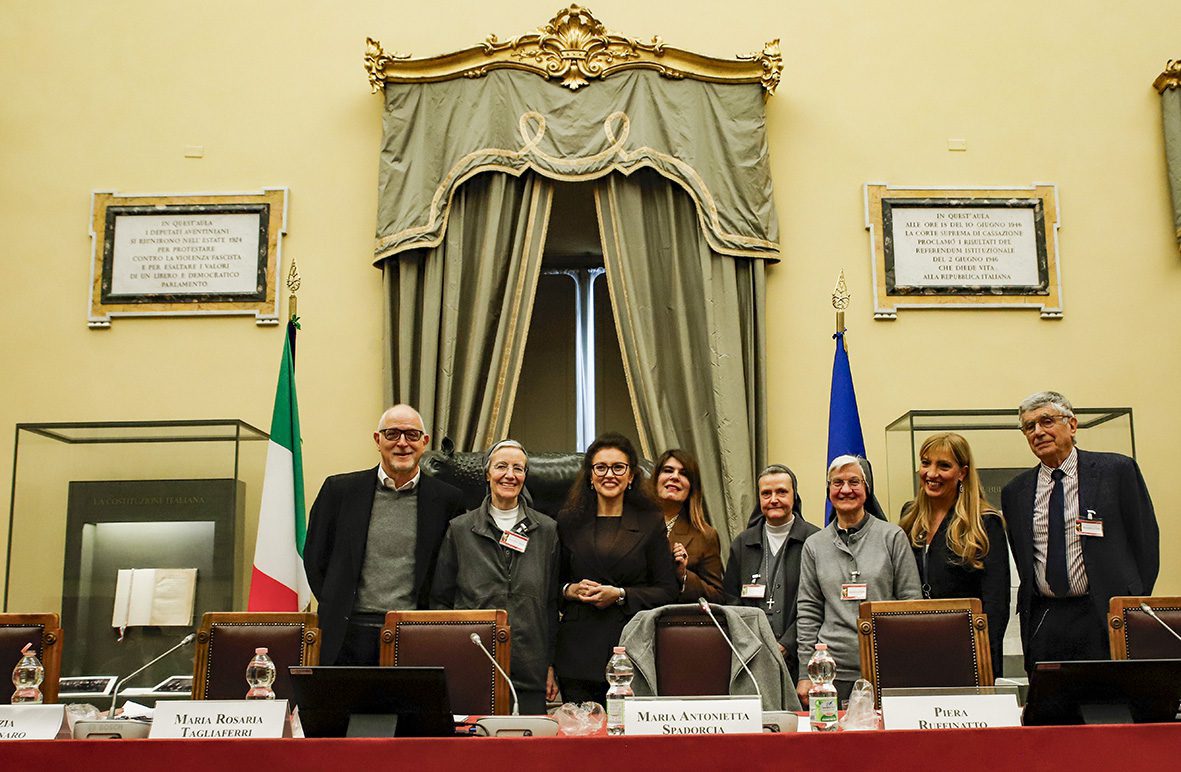
Rome (Italy). On 4 March 2026, the conference “Together for Youth: Transforming Society, Generating Change” was held in the prestigious Sala della Lupa of Palazzo Montecitorio in Rome. This event marked the launch of the “Networked with Salesian Women” Association, a Third Sector Organization (ETS), which coordinates over 200 educational presences of the Daughters of Mary Help of Christians throughout Italy.
Present in the hall were Sister Gabriella Garofoli, Provincial of St. John Bosco Province (IRO); Sister Jessica Salvaña, Superior of the Mary Mother of the Church (RMC) Preprovince; representatives of the Associations, along with various employees and collaborators; Father Elio Cesari, Salesian of Don Bosco, President of the National Center for Salesian Works (CNOS); representatives of the Pontifical Faculty of Educational Sciences “Auxilium” in Rome; representatives of young people from the Civil Service; and numerous FMA Sisters and lay people from across Italy. Also present, were Sister Ena Veralís Bolaños, General Councilor for Administration of the FMA Institute; Sister Ausilia De Siena, General Councilor for Social Communication; and Sister Nilza Fátima de Moraes, General Councilor for Formation.
The proceedings were conducted by Maria Antonietta Spadorcia, RAI journalist and Deputy Director of TG2. Before giving the word to the Honorable Maria Teresa Bellucci, Deputy Minister of Labor and Social Policies, she emphasized the word “sharing,” which her children learned at the Salesian school and then passed on to their parents. “Today we want to share not only the birth of an Association, but a commitment. We want sharing—in front of the children present here—to be the driving force of their future, of everything we do. This bond, this dialogue between the Catholic world and the Institutions, this ongoing dialogue with civil society, is truly the sharing of values, projects, and perspectives.”
The Hon. Bellucci said she was “honored to have been designated patron of this wonderful initiative and proud to support the Association,” in keeping with a vision of social policies “that brings us together: public institutions, third sector organizations, and all people of good will, including those in the private sector, who decide to collaborate to ensure that politics can increasingly have an anthropocentric vision.”
On behalf of the Superiors of the seven Italian FMA Provinces, Sister Angela Maria Maccioni recalled the historical origins of an Institute founded in 1872, “in the footsteps of women who were already working to bring about social change ‘for’ and ‘together’ with young people.” The Institute has never stopped addressing a fundamental question, “How can we support young people, especially the most vulnerable, so that they can grow, develop, and become protagonists of their own lives?” She continued, “‘Together for Young People’ is not just the title of this event. It is our way of being. For us, transforming society means starting from relationships, creating healthy educational environments, and fostering collaborative networks. Generating change means investing in education as a fundamental lever for building the future.”
Sister Mara Tagliaferri, FMA, President of the Association, then introduced the proceedings by explaining the nature of the Association: “Networked with Salesian Women was born from the desire to give a visible and unified face to the mission carried out by the Daughters of Mary Help of Christians and the laity. A widespread presence throughout the Country, expressed in various educational and pastoral settings, with a particular focus on young people living in situations of greatest educational, existential, and economic hardship, and on the advancement of the woman.”
She explained the process as follows: “In recent years, thanks to the 2017 Third Sector Code law, even within our religious Provinces, we have witnessed the strengthening of the Associations already promoted by our Institute in Italy and those co-promoted with the Salesians. Paths of collaboration have also opened up with others who recognize the values we promote. A great work of co-responsibility is increasingly developing with lay people, volunteers, and supporters who have chosen and desired to dedicate their time and skills to this beautiful mission. ‘Networked with Salesian Women’ is not just a bureaucratic entity. It aims to be a living organism that shares experiences, projects, and skills to generate life and give hope to new generations. A shared journey, because today more than ever, it is necessary to join forces to build value and a future.”
The Association is a national educational network that reaches more than 86,000 minors and young people every day with the support of 770 volunteers and over 3,400 paid staff (formators, teachers, and educators). The network includes 85 youth centers, 52 formation centers and employment services, 180 schools, 12 community centers and family homes, and 37 volunteer associations.
We then entered into the heart of the Conference, first outlining the current and future scenario and challenges, based on a competent and accurate analysis of Italian demographic and statistical data provided by Dr. Cinzia Castagnaro, Senior Researcher at ISTAT and Professor of Demography and Statistics. The focus was on young people and women, “because they play a key role in demographic transformation processes and, precisely because they are exposed to the risk of inequality, represent a decisive lever for building inclusive development models.” Dr. Castagnaro’s presentation offered an optimistic outlook on the world of volunteering. Despite a decline in the number of volunteers, the intensity of volunteer work, the formation of volunteers, and the number of hours dedicated have increased.
Remaining in the social sphere, Amedeo Piva, President of Vides ODV, highlighted the transition “from a stable to a fluid situation, in which change becomes the norm and the ability to quickly adapt to changing conditions is the winning element. We win if we know how to adapt to change.” Hence the need to sow values and engage the younger generations in experiences and activities, focusing, following the example of Don Bosco, on the quality of educational relationships based on trust. “Being witnesses of hope, to allow young people to project themselves toward their future and experience coexistence between young people and adults, engaging in this alliance.”
Michele Marmo, President of AssociAnimAzione, then considered educational networks. At a time when it’s perceived that “solidarity networks have become somewhat weakened and therefore closed,” he believes the mission of educational work is “to attempt to begin with a patient reweaving of social bonds within the community.” This makes networking even more meaningful, as a way to “respond to situations of disadvantage,” not just as a ‘technical’ response, but as a choice of fraternity, “reactivating the capacity for neighborhood, for closeness… where it’s possible to experience this dimension of connection,” and making room for young people, investing in places that can be ‘community training grounds,’ and building shared relationships between generations to experience “Together with Young People.”
“Starting from Young People: The Salesian Proposal Today” was the theme of the presentation by Sister Piera Ruffinatto, Dean of the Pontifical Faculty of Educational Sciences “Auxilium.” Drawing on charismatic sources, she reiterated Don Bosco’s educational perspective. He saw the young, “not as a problem to be contained, but as a resource, a person to be accompanied with confidence in their abilities,” and his famous phrase, “In every young person, even the most unfortunate, there is a point accessible to goodness” as a “true educational and social paradigm.” Sister Piera then summarized the Salesian proposal in three fundamental dimensions—adult presence, the space of the pre-political, and the network as a method—providing three avenues for work. “Starting from young people also means accepting that protagonism brings uncertainty, error, and experimentation. It means to stop expecting perfect results and understanding that education is a process, not a performance,” she affirmed. And recalling the Association’s aim, “to be a bridge between young people and their communities, a laboratory for participation, a space to activate educational pacts, social innovation processes, and youth empowerment programs,” she reiterated “a trait that has been dear to us since the beginning, the centrality of the education of young women.”
Monsignor Claudio Giuliodori, President of the Episcopal Commission for Catholic Education, Schools, and Universities of the Italian Episcopal Conference (CEI), made his presence felt through a video message in which he spoke of the new Association as a “prophetic sign” for the times we are living in, capable of offering a renewed and effective approach to the plight of the younger generations. “Generating change with the Church and in the Church” and walking with young people, standing alongside them, drawing close to them, and taking responsibility, in accordance with the synodal style, are the perspectives he shared.
“Don Bosco always knew how to see beyond and had the courage to make his vision a reality for the good of young people. It is our duty to keep our gaze broad, to cultivate hope in every daily action so that the dream in the hands of so many young people may become a reality!” concluded Sister Mara Tagliaferri, greeting all who attended this enriching conference launching a new experience for the Italian communities of the Daughters of Mary Help of Christians.






Navigo sul nostro sito al tempo opportuno: trovo interessante anche questo articolo tra gli altri ultimi gia’ considerati in precedenza; sono sempre una notizia nuova, significativa da imitare nel realizzarla applicandola alla propria realta’ culturale e all’ambiente educativo in cui siamo e operiamo.
“Insieme per i Giovani: trasformare il sociale, generare il cambiamento”. Missione davvero impegnativa che richiede oinvolgimento-partecipazione sinodale con la massima fiducia che i giovani, le giovani stessi corrispondano attivamente, creativamente, capaci anche di sollecotare noi adulti. E’ molto incoraggiante che le stesse Consigliere Generali, altri, altre persone altamente preparate ci offrono la possibilita’ di qualificare la nostra presenza educativa in sintonia con il tema del convegno. L’assunzione di questo impegno educativo sia mezzo ad educarci e educare alla pace fraterna mentre ci riconciliamo con Il Padre. Grazie per tale condivisione