
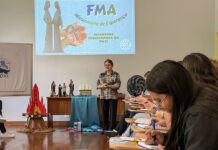




Rome (Italy). The second part of the series of webinars dedicated to catechetical methodology, promoted by the FMA International Commission on Catechesis was held in live-streaming from 9 to 15 December 2025. Numerous catechists and communities participated in the webinars, confirming the urgency of renewed momentum in the proclamation of the faith.
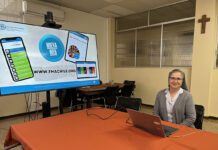
In this context of international discussion, the Commission interviewed Sister Josmy Jose, professor of Catechetical Methodology at the Pontifical Faculty of Educational Sciences “Auxilium” and a member of the Commission itself. Her reflections offer a light on the path begun to respond to the call of General Chapter XXIV, to “give a new impetus to catechesis”.
Regarding the preparation of the themes for the seventh webinar, Sister Josmy highlighted how this was, more than a work of method, a true exercise in personal and ecclesial discernment. The main challenge was not to “say it all”, but to select the essential: that which can actually help today, to generate faith.
This required a fundamental shift in perspective: to conceive of catechesis not as an orderly transmission of notions, but as a concrete mediation of God’s action in people’s lives. As the Directory for Catechesis recalls, “the itinerary of faith is a gradual and continuous process” (n. 61), which respects the maturation times of each, a crucial aspect in an era of profound cultural and generational transformations.
Sister Josmy also emphasized that catechetical design is in itself a spiritual act. It’s not just about planning activities, but about listening to the Spirit, the authentic questions of communities, the labors and expectations of catechists, families, adolescents, and young people. Designing a path means starting from concrete people, their cultural context, their existential questions, integrating proclamation, celebration, testimony, and charity into a single experience of faith.
Among the topics addressed, two in particular emerged as priorities: the need to conceive of the itinerary as a true process of initiation into Christian life, overcoming the reductive vision of a simple succession of encounters; and the urgency of rethinking catechesis methods with adolescents and young people, who grow up in a digital, fragmented, and highly experiential cultural context.
On international participation, Sister Josmy noted that beyond the numbers, the greatest value emerged in the quality of sharing and dialogue. The interventions, questions, and resonances created a space for mutual listening that enriched all participants, from very different cultural and ecclesiastical backgrounds. A deep desire emerged from the contributions, not so much to “learn new techniques”, but to rediscover meaning, direction, and trust in one’s catechetical service, feeling part of a common journey. Webinars were perceived as a space for accompaniment, recognition, and communion.
Regarding the concrete implementation of the slogan, “Together to give a new impetus to catechesis,” Sister Josmy noted that signs of this dynamism are already observed in various Provinces, especially where work is carried out in a more synodal manner, involving catechetical teams and investing in continuing education. The new impetus emerges when catechesis ceases to be an isolated “sector” and becomes a shared process, connected to liturgy, community life, and mission. For example, there is a greater attention to the annual design of itineraries and the care of meetings as real “events of grace”.
However, significant resistance remains, especially related to the shift in mentality: abandoning the security of known patterns and standardized programs to embrace an accompanying logic that requires time, listening, and patience. In some contexts, a functional vision of catechesis persists, mainly linked to sacramental preparation. The deepest challenge, therefore, is not only organizational, but spiritual and cultural: truly believing that faith grows through processes and that the educator’s job is to prepare the ground, not control the results. The future of incisive catechesis is played out in the ability to hold together design rigor and docility to the Spirit.
The journey continues. The formation cycle continues from 9 to 15 March 2026, with the webinar dedicated to methodology in catechesis (third part).
Videos are published on the You Tube channel YouTube FMA Ambito PG, where you can also find a link to download the material used.