





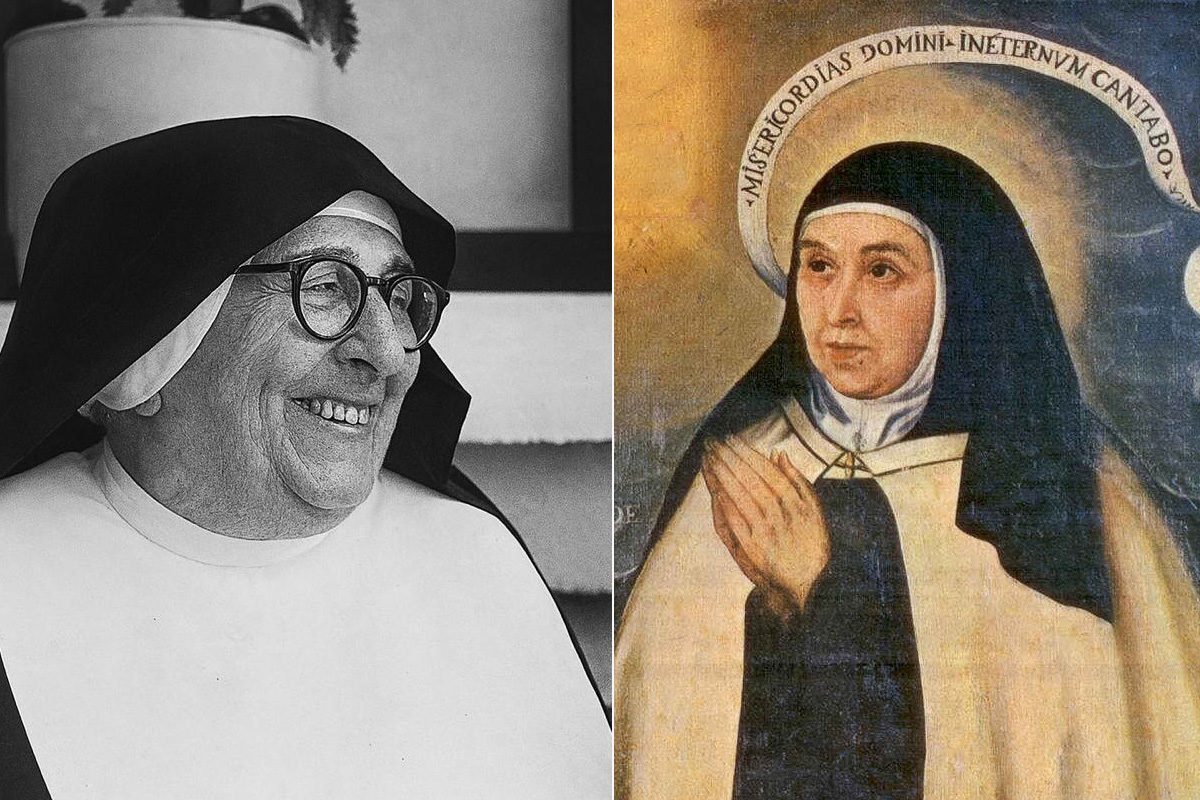
Rome (Italy). October 15, 2025 marks the liturgical memory of Saint Teresa of Avila, (1515 – 1582), chosen by Don Bosco as patroness of the Institute of the Daughters of Mary Help of Christians.
In the Constitutions of 1885, Don Bosco wrote in the article concerning the Mistress of Novices: “St. Teresa wanted religious women to be cheerful, sincere, and open… The Sisters of this character are the most likely to inspire esteem and love for piety and religion in young girls and people of the century” (Rules or Constitutions for the Daughters of Mary Help of Christians aggregated to the Salesian Society, Turin 1885, Tit. IX,5).
Certainly, Don Bosco wanted to give the FMA a teacher of spiritual life who knew how to combine contemplation and action in a harmonious synthesis, the true root of the creative resourcefulness of the great Spanish reformer and founder.
The original FMA, however, had difficulty living like this. In a letter from Borgo San Martino, Sister Luigina Boccalatte wrote that between 25 and 29 June 1882, Don Bosco came to celebrate Holy Mass on the days of the feast of St. Louis Gonzaga. “I won’t tell you about the extraordinary work and how many people he gathered, even from neighboring towns.” The Sister says, “We told him [Don Bosco] that we didn’t have time left for our practices of piety and that in the evening, we fell asleep. And He, “Recite three Hail Marys as best you can, and go to bed calmly, because you are already tired from the day; but in Mass and Communion repeat to Jesus that He give you health, holiness, joy, and perseverance, and that He make you like Holy Terese” (Cron. IV, 155 – 156).
Also Blessed Sister Maria Troncatti, FMA (1883 – 1969), who on 19 October will be canonized by Leo XIV in Rome, in St. Peter’s Square, knew how to join contemplation and action, witnessing with equal strength, trust in God and in Mary Help of Christians and apostolic creativity and daring.
Witnesses affirm, “Prayer was her daily food. She loved being in the chapel despite the limited time available. She took advantage of the early hours of the day, those when the sick nap and those of the afternoon… and prayed! However, when she was called to assist the sick, she immediately left the chapel to go and take care of the needy.”
As a novice, she had written words that echo Teresian spirituality, “Lord, I want to be Yours forever. O Jesus, I have left all that was dearest to me to come to serve You, to sanctify my soul. Yes, I have abandoned everything. You alone remain with me now, but You are enough for me.
Jesus, make me so good and persevering in the state to which You have called me. Grant that I may always serve you faithfully! Let me be forgotten by all to be Yours alone; turn me away from all to be your trinket. Give me so much love, so much spirit of sacrifice, of humility, of self-sacrifice in order to be an instrument of good to many poor souls.” These words were found among her things after her death.
In the documentation of the Beatification Process we read: “How did Sister Maria live prayer? (…) we can assert that the Servant of God always lived on the heights of prayer, and that therefore – as was said of the founder Don Bosco – ‘she was union with God’. She imitated the attitude of Jesus who ‘spent the night in prayer’ and who, after His baptism in the Jordan, ‘was there praying’. Sister Troncatti placed herself in adoration in front of the tabernacle every morning from 4 to 5. This is how she opened the day; then, on Saturday, she participated in the ‘rosary of the dawn’ with the pious faithful, then to find herself at the appointed time in church together with the community for meditation and holy mass.
Throughout the day, she not only made work an incessant prayer, but prayed almost continuously. Many testimonies demonstrate this, from people of the most diverse categories, who saw in her attitude the transparency of a serene, convinced, industrious faith.”
A postulant who met Sister Maria in 1920 says, “She was never seen as anxious or busy, yet always industrious, with an attitude of peace that revealed an authentic interior ‘recollection’ of a person immersed in God.”
As Saint Teresa teaches, “Sister Maria lives every moment of her life in a courageous projection of faith that illuminates her path in the most difficult circumstances. Her confident abandonment into the hands of God, provident Father and infinite Love, makes her neither passive nor disarmed. She knows that in the Lord’s vineyard, it is the sun of grace that ripens the fruits, but the hard-working and industriousness of the workers is also needed. Therefore, her efforts are relentless: from the grandiose project of the hospital to the interest in ensuring that the little Shuar has a beautiful dress for the feast of baptism or first communion; from Marian celebrations to the interest in the bride of her godson who has to go to the city.
Her intense activity is entirely marked by the rhythm of prayer. “A glance at my crucifix that I have around my neck gives me life and wings to work” (L. 16 – Proc. p. 67). She repeats to herself what she writes to her relatives, “Jesus gave His blood also for these unfortunate people” (Summarium, 517).
And thus, two Saints so different, distant in time and space, recall each other and encourage the man and woman of today to live faith as a transformative and humanizing power in today’s context.

Thank you, beautiful testimony. She lived in the presence of God
Grazie di questo messaggio;mi aiuta a vivere in compagnia di SR.Maria Troncatti il mio cammino di fede