


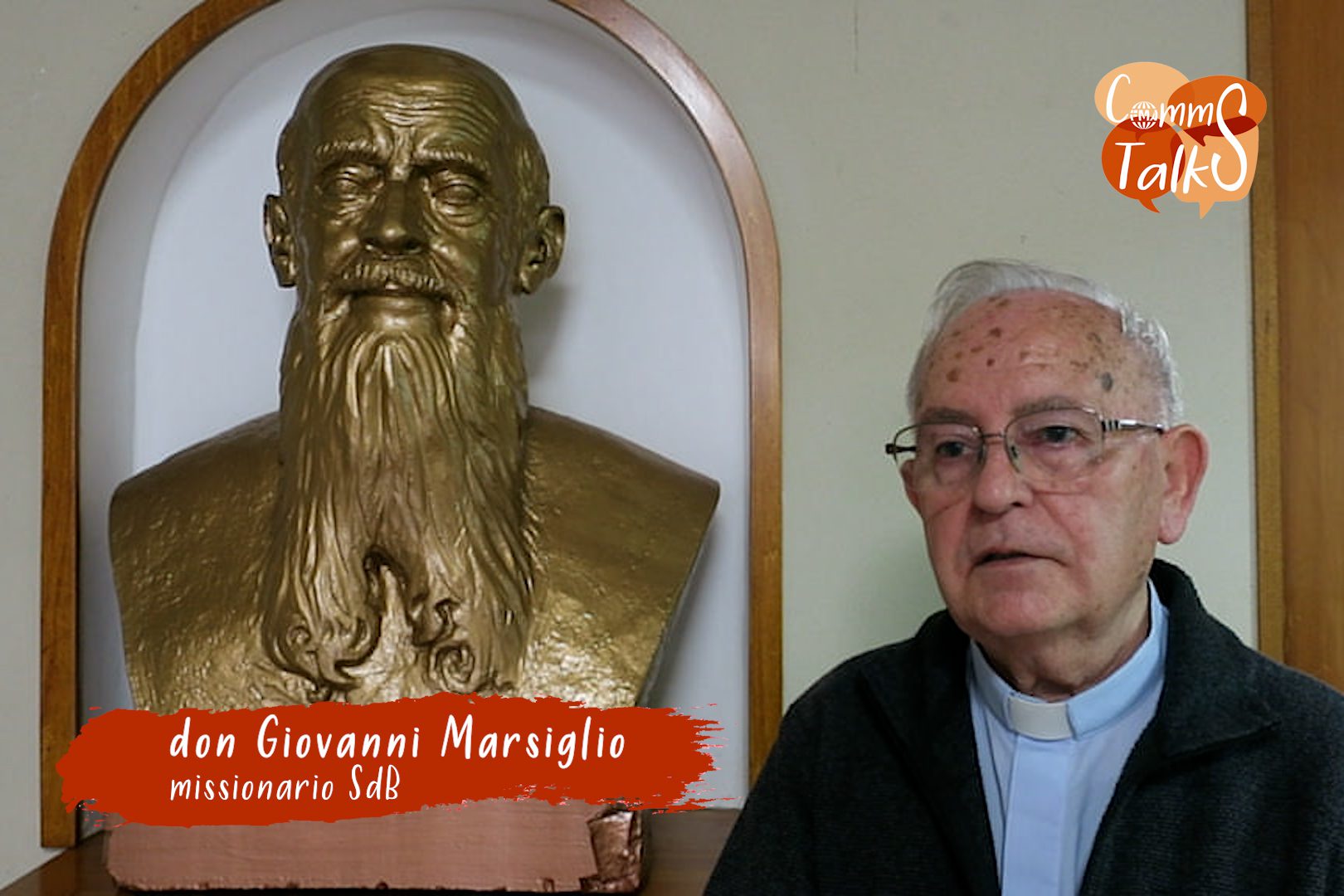
Rome (Italy). In the 15th video of the CommTalkS – the initiative of the Communication Sector of the Institute of the Daughters of Mary Help of Christians, with the aim of creating a shared vision of the culture of communication –Fr. Giovanni Marsiglio, Salesian of Don Bosco, missionary, head of the Cimatti Museum in Chōfu, on the outskirts of Tokyo, tells the life of the Venerable Monsignor Vicenzo Cimatti (Faenza, 15 July 1879 – Chofu, 6 October 1965), missionary in Japan.
At just three years of age, after the death of his father, Vincenzo has the opportunity to see Don Bosco, visiting Faenza with the desire to build his school. “Vincenzino, look, look at Don Bosco!” his mother would tell him, lifting him up. And that face will remain in his memory for the rest of his life, so much so, that Fr. Cimatti will be defined “the Don Bosco of Japan”.
At 17, he became a Salesian and was sent to Turin-Valsalice, where he taught and obtained various degrees: a high school and composition diploma from the Conservatory of Parma, a degree in agriculture, philosophy, and pedagogy from the Royal University of Turin, so much so that he was known as “the master”, “not only because he taught these various subjects from which he had obtained his license and degree, but because he taught them how to live life as Christians,” explains Fr. Giovanni.
He was a respected soprano and composer, and his operettas were performed in Salesian schools and oratories. When he was already 46 years old, he was sent by Fr. Rinaldi to found the Salesian work in Japan, where he worked for 40 years. “He became famous above all for his music, for his concerts. He basically toured almost all of Japan at the time, doing concerts and always giving a conference on religion in the concert.”
He wins the hearts of the Japanese with his goodness by committing himself, like Don Bosco, to the apostolate of the press and music. He has performed around 2,000 concerts in Japan. Despite the difficulty of the language, he becomes the first Provincial and also calls upon the Daughters of Mary Help of Christians. “At that time, he was already considered a saint. His way was to try to move forward with the system of St. Francis de Sales,” says Fr. Giovanni.
He testifies that Fr. Cimatti was loved by everyone, not only by his confreres, but also by all those who approached him and that his fame spread after his death:
“He died in 1965, surrounded by all his confreres. I was present too; there were 40 of us, 30 clerics and ten superiors. He died like a candle, extinguishing like a candle, during the celebration of Mass that was done in his room.
And then began the fame of his holiness. In 1982, this museum was built where we preserve his music. We receive many photographs, which concern his life both in Italy, in Faenza, and in Valsalice, as well as especially here in Japan, in the houses where he worked.
Every month, on the day of remembrance of his death, we celebrate the mass that commemorates him. He was declared Venerable in 1991 by John Paul II. Many people go to his grave every day.”
The Cimatti Museum opened to the public in 1983, with the aim of preserving the memory and raising awareness of the Venerable’s life and work. Fr. Giovanni Marsiglio’s testimony is accompanied by some images from Fr. Cimatti’s important collection of musical compositions, documents, books, photographs, homilies, letters, and personal objects, as well as fossils, minerals, plants, shells, algae, insects, and butterflies visible in the museum.
The video is available with subtitles in some languages (from YouTube settings). All CommTalks remain available on the Youtube Channel CGFMANET and can be retrieved from the side banner on the home page of the Institute’s website.