



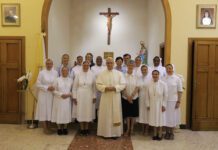
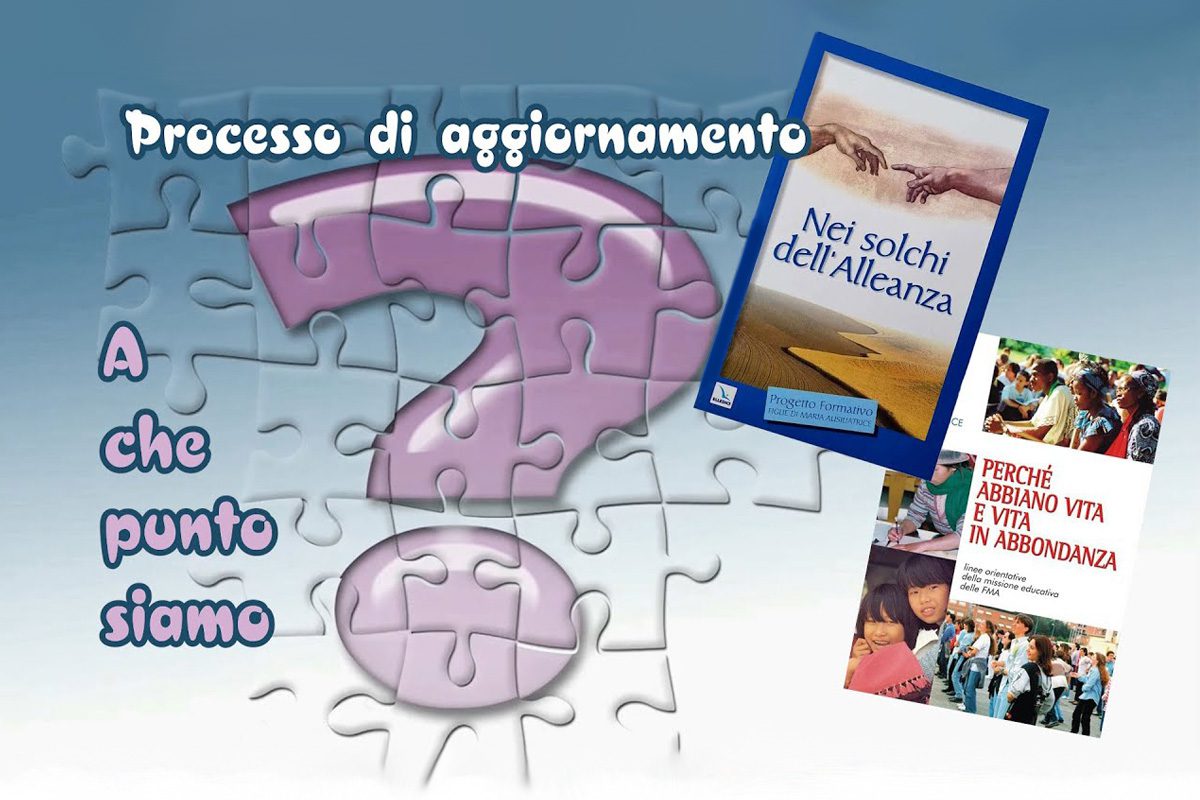
Rome (Italy). During the Triennial Verificas carried out by the various Interprovincial Conferences around the world, which ended in August 2025, Mother Chiara Cazzuola and the General Councilors, via video, presented the process and status of updating the documents of the Institute of the Daughters of Mary Help of Christians – “Formation Plan” and “Guidelines of the Educational Mission” (LOME) – and involved the participants in a work of reflection and collection of proposals to be kept in mind when drafting the documents.
Responding to some questions, Sister Enrica Ottone and Sister Martha Séïde, Professors of the Pontifical Faculty of Educational Sciences “Auxilium”, illustrate the steps of this process, born from the mandate of the XXIV General Chapter and started in August 2022, of which the first responsible are the Youth Ministry and the Formation Sectors, with the involvement of the Communication Sector and the Sector collaborators, consulted in various phases.
The premises
The working group, together with the General Council, asked first of all the final result that it wanted to achieve from this path and identified, as a first characteristic, that it be a participatory and transformative experience and that it would lead as much as possible, to an involvement of the entire Institute, both the FMA and people in formation, lay people and young people.
The reason for Focus groups
Strengthened by the positive experience of the Focus groups methodology used on the occasion of the 150th of the Institute, it was decided to adopt it in this one also. To choose the people, the group followed the instructions of the General Council and consulted the Conferences, subsequently activating formation for facilitators. In total, 682 people participated, of which there were 140 lay people; 85 Focus groups were created and 2,394 responses and 390,292 words were collected. These data give an idea of all the work put in place to involve a significant group and thus have a representative sample of the whole world.
The results of the Focus groups
The answers to the Focus groups’ questions were collected around two large nuclei and analyzed with qualitative analysis software by FMA with a mastery of different languages. A first nucleus consisted in identifying what the interviewees said with respect to the structure, language, contents, and form of the document. Other aspects concerned the main cores of documents identified within the journey, such as the need for joint formation between FMA and lay people on various aspects of the educational mission, but also of formation. The experience shared by respondents was also gathered. This work resulted in a report of about fifteen pages for each document.
Rereading and analysis of the previous documents
After the Focus group phase, in the summer of 2024 we moved on to the rereading and analysis of the two documents. About twenty Sisters from the different continents and contexts of the world were identified by the General Council in order to be able to collect – starting from the results of the previous phase – indispensable elements, obsolete elements, new elements to integrate, elements common to the two documents, and language to use. The essential elements have been collected in a report that will be reviewed by the General Council, with which the working group has maintained a continuous discussion, enriched, at times, by that with the Sector collaborators.
After the analysis work
Two subgroups took the two reports into consideration with the return of the results of the Focus groups and the more in-depth analysis made by some Sisters on the two previous documents, to identify the common nuclei emerging from the overall work. Some criteria for revision emerge from the Focus groups and sharing. Two streamlined documents are desired which, in addition to a prospective framework, indicate guidelines; a clear, effective, understandable format, with attention, already in the construction of the text, to translations; an effective transmission process, to have a transformative impact, with respect to the contents that will be updated.
The next step
Mother and the Council made the decision to communicate this process during the Verificas, so that the Interprovincial Conferences would be informed, and could in turn communicate it to their own Provinces, involving the whole Institute at least in understanding the de facto state of the process. In the three-yearly Verificas, in addition to recounting the various steps, participants were given the opportunity to propose further suggestions to integrate.
The themes that emerged
Along the process, some central themes emerged, which it was deemed appropriate to explore together in order to have a common “mens” and enter in a unified way into this educational and formative process, such as adult education or how to form the new person of the Beatitudes and form young people along this line. During the Triennial Verificas, the participants have already reflected on the possibility of considering the Beatitudes as the “red thread” of the two documents and on how to experience them in the Salesian style.
In the meantime, between February and May 2025, a reflection was carried out on topics transversal to the two documents, the summary of which was shared with the General Council. On 11 July 2025, the working group presented the draft outline of each document to the General Council.
The expectations
The hope is that, through the information that will continue to be shared, the process may have a real impact on the entire Institute and the path may truly have a transformative impact from the vocational and the mission point of view.
Previous News:
For a renewed and synodal charismatic-missionary process




Muy interesante la propuesta de una formación conjunta entre laicos y hermanas. Algo que ya se viene haciendo en Argentina. Cómo también la educación de adultos que pertenecen a la familia de nuestros jóvenes. Otro tema a tener en cuenta es fomentar la participación en los encuentros intercongregacionales.
Grazie per questa informazione, essenziale almeno per seguire…
Il lavoro è molto e accompagno con la preghiera, perché sia per la crescita di ognuna e per il futuro dell’Istituto.