




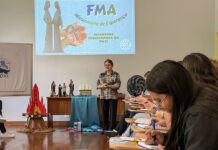

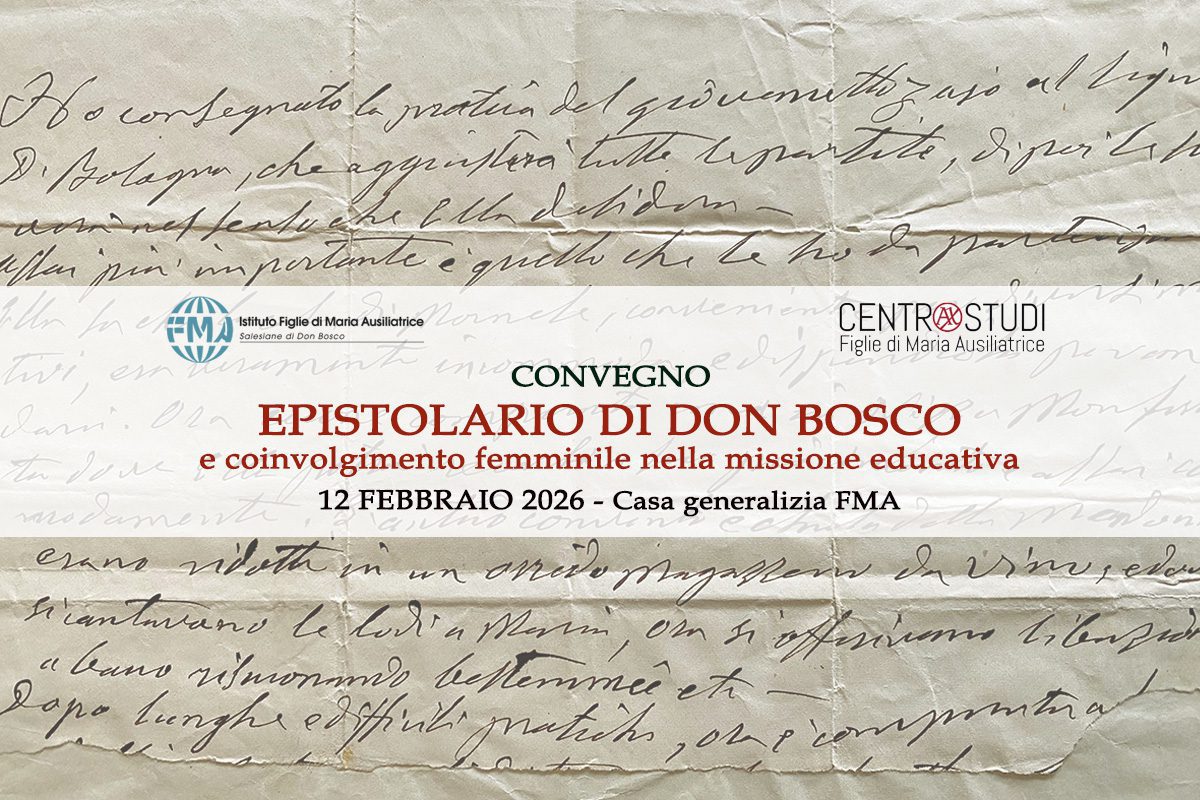
Rome (Italy). On 12 February 2026, at 3:00 PM, a conference will be held in Rome at the General House of the Institute of the Daughters of Mary Help of Christians to mark the completion of the critical edition of Don Bosco’s Epistolary, promoted by the Institute and the Center for Studies on FMAs of the Pontifical Faculty of Educational Sciences “Auxilium”.
“Don Bosco’s Letters and Women’s Involvement in the Educational Mission” is the theme of the Conference, which will open with greetings from Mother Chiara Cazzuola, Superior General of the FMA Institute, and Fr. Silvio Roggia, General Councilor for Education of the Salesian Congregation.
The presentations of the speakers will follow, moderated by Sister Maria Luisa Nicastro, Secretary General of the FMA Institute:
- The influence of the Virgin Mary on Don Bosco the educator – Prof. Piera Silvia Ruffinatto, FMA
- Don Bosco and the lay-women Cooperators – Prof. Eloisa De Felice, SSCC
- The Daughters of Mary Help of Christians in Don Bosco’s Epistolary – Prof. Grazia Loparco, FMA
- Letters of Don Bosco, to various religious – Prof. Eliane Petri, FMA
- Intervention by the curator – Dr. Francesco Motto, SDB
In Don Bosco’s monumental correspondence, the recipients are more than a thousand, of all ages, backgrounds, and roles. The letters exude the intense experience of the brilliant organizer, who recognizes himself as entrusted with the task of preparing boys and girls for adult life through education, under Mary’s guidance. In order to implement it widely, he involves many people in the same undertaking. As he knows well from the beginning, for such a commitment the Salesians are not enough.
Faced with a socio-religious situation that evolves with gradual secularization, he feels the urgency of defending the essential Christian values and, at the same time, realistically creating the conditions to form people worthy of the times. If governments are distancing themselves from the Church, new allies must be found in society itself. What is needed are men and women religious, men and women lay people ready to collaborate, each according to their own vocation and possibilities, with an industrious faith, the soul of devotional practices. Thus, within a broad horizon of apostolate, over time the collaborators of Salesian work multiply: men and women cooperators, representatives of ecclesiastical and civil institutions, friends, benefactors consulted for help and cooperation in the great enterprise and at the same time, well present in the thoughts and prayers of Don Bosco.
Experience teaches him that also women can effectively assist in the work of salvation, no longer just through prayer and charity, but in the apostolate radiated and innervated in families and society. And so, even if as a man and priest of his time, he suffers from a traditional mentality, he nevertheless allies himself with many women for a charity with a modern, promotional face, aimed at saving the present and future of many young people. Above all, Don Bosco has a modern idea of female religious life, aimed at the urgent purpose of educating girls from the working classes, with a simple and familiar style.
As the founder of the Institute of the Daughters of Mary Help of Christians (FMA), which he wanted incorporated into the Salesian Congregation as an integral part of the educational project, it can be assumed that the letters sent to them outnumbered the few that remained, while admitting that communication had to take place more in person and through the Directors he designated. Out of 4682 letters, in fact, a minimum percentage is reserved for FMAs. However, there are more numerous references to them when he writes to interlocutors he intends to involve in the educational work, proving his idea that it was a single Congregation with two branches.
Paying attention to the female component, starting from the Marian inspiration of the entire Salesian work, one wonders how the Virgin is present in the correspondence. By then limiting the study to the interlocutors of Salesian work, what space did he reserve for women religious, and Cooperators? How did Don Bosco communicate with and about FMAs? Where was the novelty, compared to the flourishing of contemporary women’s congregations? With respect to common prejudices, how did he make himself available to go further and to what extent, with a view to the priority goal to be achieved?
These are some of the questions that will fuel the debate during the Conference.





Saludos desde la amazonia de Ecuador, Tutinentsa, gracias por este maravilloso regalo de Dios a través de esta iniciativa.