




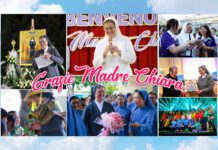
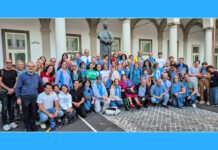

Rome (Italy). On 13 May 2025, on the Liturgical Solemnity of Saint Mary Domenica Mazzarello, Cofounder of the Institute of the Daughters of Mary Help of Christians, the Generalate of Rome had the joy of welcoming Fr. Fabio Attard, Rector Major of the Salesian Congregation, 11th successor of Don Bosco and center of unity of the Salesian Family.
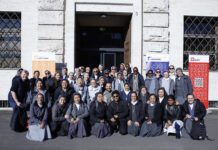
The Eucharistic Celebration, presided by the Rector Major and concelebrated by his Secretary, Fr. Thathireddy Vijayabhaskar, was attended by some General Councilors and the FMA of Mary Help of Christians Community (RCG), the President of the World Confederation Mornese FMA Past Pupils, Maria Carmen Castillon, the Community San Biagio of Subiaco, St. John Bosco Province (IRO), and some relatives of the FMA.
“In the name of Mother, of the other General Councilors, present or elsewhere in the world, but spiritually united to us, in the name of all of us, I express gratitude for having wished to preside at the Eucharist on the liturgical solemnity of St. Mary Domenica Mazzarello, our Cofounder, for the first time as Rector Major. We are truly happy!
We who are here in the General House represent, in some way, all the Daughters of Mary Help of Christians in the world. With them, we recognize in you Don Bosco among us, that father who wanted us to be a ‘living monument of gratitude to the Help of Christians’. Finding ourselves together today around the Eucharist, in Jesus, is an opportunity to strengthen the bonds that unite us in a communion that makes us credible witnesses and heralds of Christ to young people.” These are the words with which the Vicar General, Sister María del Rosario García Ribas, welcomed the Rector Major, expressing her joy and gratitude for his presence.
In his beautiful homily, Fr. Fabio, dwelling on the Gospel image of the vine and the branches (Jn 15:1-10), stressed the absolute centrality of Christ, the Vine, “the unique source of the lifeblood, the love that animates, and the love that sustains”, the need to “remain” in Him, as an “active, daily choice”, through “fidelity to the vows, to fraternal life, to personal and community prayer, even when the external or internal panorama appears arid.”
He spoke of fertility as a gift and result of union, not as an obsession with performance, in which the main concern must be, more than the “result”, one’s own adherence to Christ. The image of vines and branches, continued Fr. Fabio, “is not idyllic. It also contemplates the pruning, the necessary purification carried out by the Father vinedresser.” Moreover, even in the face of challenges of individualism and internal tensions, this image also has “a strong community value. The branches are not isolated, but they are all grafted on the one Vine”, with the “serious warning”, enclosed in the passage of John, that “the branch that does not remain united to the vine, withers and is gathered and thrown away.”
How does the experience of Saint Mary Domenica Mazzarello reflect the metaphor of the vine and the branches?
To this question, the Rector Major answered by reviewing the spiritual and human experience of Mother Mazzarello, whom he saw as “a concrete and luminous incarnation of this image,” first of all in her deep rooting in Christ (the Vine), in her “remaining” that “was not expressed in extraordinary mystical experiences (although there were deep intuitions), but in constant and humble fidelity to daily duty, in simple and persevering prayer, in the work lived as service and sanctification (joy, work, and prayer).”
The most evident fruit of her union with Christ, Fr. Fabio pointed out, is the foundation of the FMA Institute, together with Don Bosco, not “a personal project of her own, but the reception of a divine call (‘I entrust them to you’).”
Resuming the metaphor, he then stressed how “Mother Mazzarello’s life was not exempt from pruning”, as the typhus disease and the initial difficulties of the Institute, which “purified intentions and strengthened abandonment in God.”
Another characteristic lived and promoted intensely by Mother Mazzarello is “the ‘family spirit’, which is the concrete translation of Jesus’ command: ‘Love one another as I have loved you’. Her spiritual motherhood towards the Sisters and girls, her capacity to create communion, to encourage, to correct with sweetness and firmness, were the expression of the charity of Christ that circulated in her and that she ardently wished to see circulate in the community.”
Finally, joy could not be missed, as “Mature fruit,” so “her famous exhortation to joy – ‘Be cheerful!’, ‘Let us be holy by always being cheerful’ – was not superficiality, but the manifestation of the deep joy that comes from knowing one is united with Christ, loved by Him, and instruments of His love. It was the joy promised by Jesus to those who remain in Him. This joy was contagious and became an educative method.”
In summary, – concluded the Rector Major – “the life of Saint Mary Domenica Mazzarello is a splendid living illustration of John 15. (…) Her experience encourages each consecrated person to live this same evangelical dynamic in the concreteness of their own history.”
The Feast of the Eucharistic Celebration, accompanied by several songs to Mother Mazzarello, continued with a moment of conviviality in the refectory, where the Sisters, as a sign of gratitude and as an expression of the multiculturalism typical of this Community, offered the song “Es tiempo de reavivar el fuego”, official hymn accompanying the Triennium in preparation for the 150th anniversary of the first missionary expedition of the FMA (14 November 1877), based precisely on the words of the Saint, “Now is the time to revive the fire!” (L 27).
Photos: Flickr FMA


Gracias Señor por la Santidad de nuestra querida Maín.
Buona Festa!!!!
Grazie Signore, per averci Donato Maria Domenica Mazzarello!!!!
Grazie a tutte le FMA. ❤
Bruna da Monleone Ge