




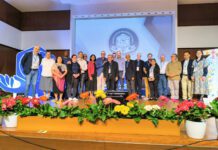
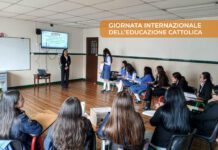
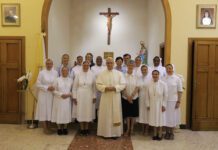
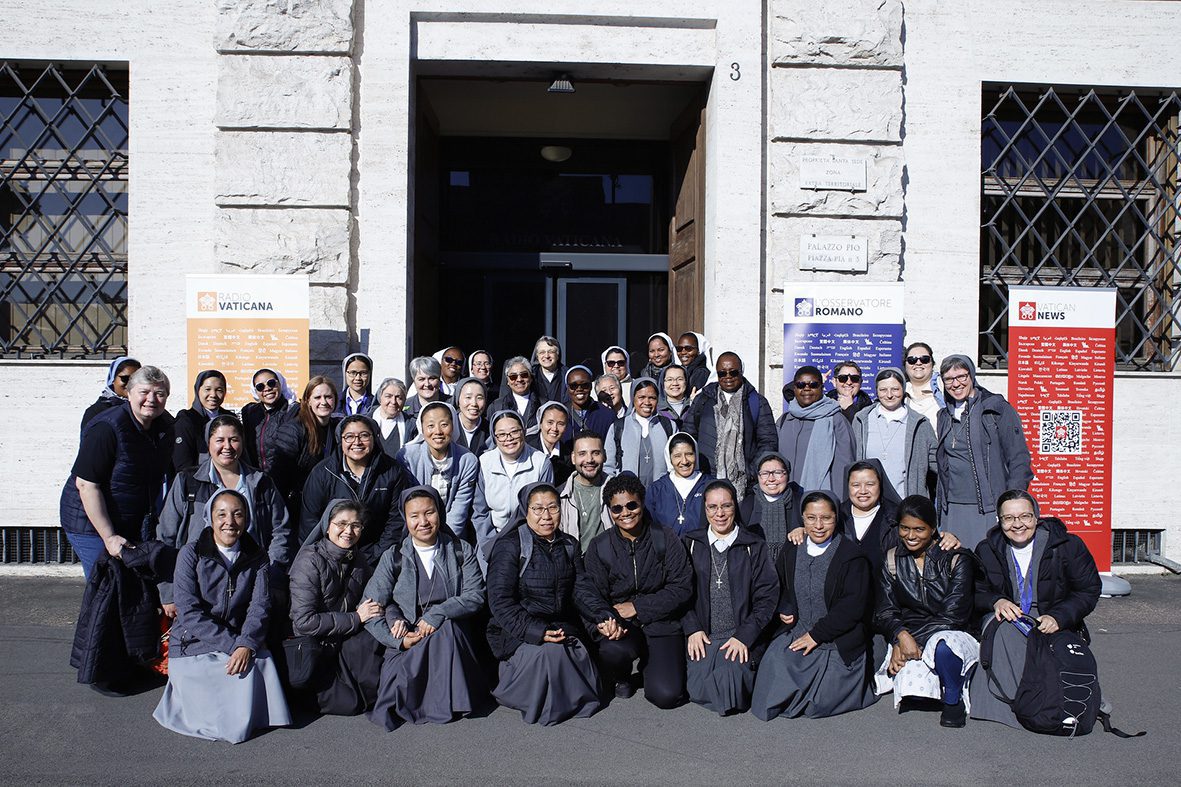
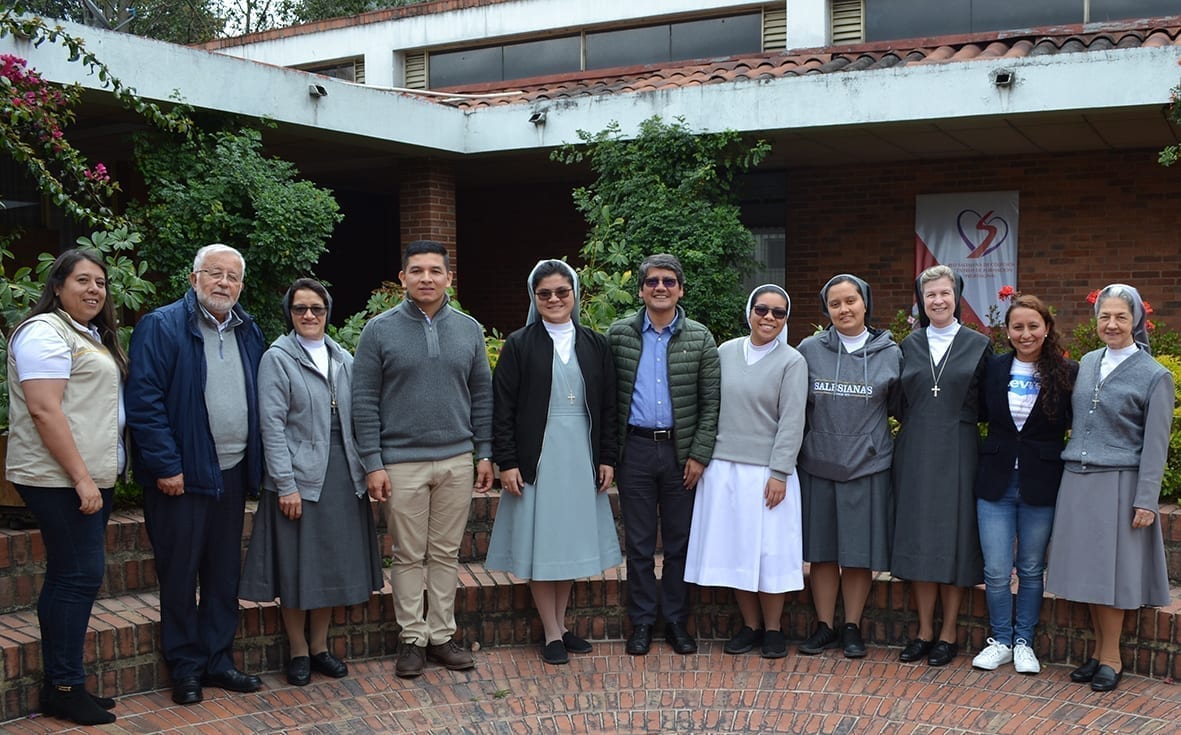
Rome (Italy). From 16 to 28 March 2026, 41 Social Communication Coordinators—Daughters of Mary Help of Christians and laypeople hailing from all the Provinces worldwide—gathered in Rome, at the Generalate, for a formation meeting organized and facilitated by the General Councilor, Sister Ausilia De Siena, together with the collaborators of the FMA Institute’s Communication Sector.
“Identity That Speaks, Network That Unites” was the theme accompanying the days, a choice based on the formation needs expressed by the participants and aligned with the directives of the 24th General Chapter: “we prioritize formation to inhabit digital environments in a conscious and responsible manner, to understand the dynamics of information culture, and to foster the development of a critical and creative mindset.” The objective was to strengthen communicative, pastoral, and charismatic competencies with the objective to reinforce within the network pastoral and charismatic communicative competencies for Salesian communicative leadership that remains consistent with the educational mission and the charismatic identity.
From the very beginning, it was evident that this was not merely a “technical” course. The proposal was, first and foremost, an invitation to recenter communication within its deepest dimension: that of relationship. In welcoming the group, Sister Ausilia emphasized the importance of cultivating a genuine culture of shared communication, one capable of transcending the logic of isolation and allowing the gifts, experiences, and unique paths of every context to shine forth. Working as a network, therefore, presents itself not merely as a functional strategy, but as a conscious choice, a mentality to be cultivated and sustained.
“A network that enables us to share experiences, support one another, and circulate ideas and best practices, but also to face difficulties together. Ultimately, within our Institute, we are already a network; the next step is to make it increasingly conscious, visible, and impactful both in our society and within the Church.”
The first few days spent at the Generalate in Rome made it possible to interpret the present with greater clarity and depth. Thanks to the contributions of experts in the field of communication from the Faculty of Social Communication Sciences at the Pontifical Salesian University (UPS)—Fr. Fabio Pasqualetti, SDB, Dean of the Faculty, Fr. Donato Lacedonio, and Tommaso Sardelli, it has been possible to engage with the challenges of the current context and recognize the need for a form of communication that is not limited merely to effectiveness, but is capable of generating meaning, particularly in our relationship with young people. In this sense, to communicate means to accompany, to interpret, and to open up new paths. It means helping to give a name to the questions and stirrings that run through contemporary reality.
This reflection has acquired particular depth in dialogue with the Salesian charism, viewed as a constitutive dimension of the mission itself, thanks to the contributions of Sister Piera Ruffinatto, FMA, Dean of the Pontifical Faculty of Educational Sciences “Auxilium,” and Sister Eliane Petri, a faculty member and coordinator of the Institute’s Spirituality Course. In the experience of Don Bosco and Mother Mazzarello, communicating means being present, fostering closeness, sharing one’s life with simplicity and authenticity, and creating environments in which every individual feels recognized and accompanied. A communicative style has emerged, characterized by joy, attentive listening, and the capacity to transform everyday life into an educational space.
The program also included the development of practical skills in the fields of communicative leadership, teamwork, and networking—facilitated by Dr. Francesca Busnelli, a psychologist and trainer; storytelling through imagery and podcasts, featuring workshops led by Prof. Tommaso Sardelli and Sr. Susana Diaz, FMA (a collaborator with the Sector); journalistic narrative, explored in depth by Sr. Maria Antonia Chinello, FMA, a professor at the “Auxilium” Faculty; and institutional communication and crisis management, a topic addressed by Fr. Donato Lacedonio. These sessions served to interweave reflection with practice, thereby fostering greater awareness and intentionality regarding situations already being experienced “in the field” within the specific contexts in which the participants are immersed.
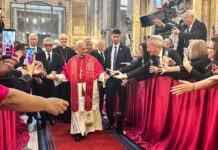
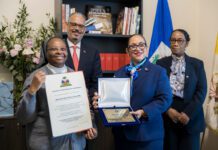
A valuable addition to the program was the series of visits to the “headquarters” of Vatican Media at Palazzo Pio, where the group was received by Alessandro Gisotti, Deputy Editorial Director of the Dicastery for Communication of the Holy See. Through a historical overview of the Holy See’s communication efforts, Gisotti spoke of “the beauty of being Church and of universality” in communicating information and stories from around the world, as well as the initiatives undertaken and the challenges embraced by Vatican Media. They were also received by Nataša Govekar, Director of the Theological-Pastoral Office of the Dicastery, who shared the Dicastery’s projects, experiences, and initiatives, with a particular focus on youth and the document “Towards a Full Presence” and by Sister Nina Krapić, the new Deputy Director of the Holy See Press Office, who focused on strategic communication and the image of consecrated women online. The morning continued with a visit to the historic headquarters of Vatican Radio, commissioned by Pius XI and designed by Guglielmo Marconi, nestled amidst the lush greenery of the Vatican Gardens, as well as to the “Master Control Room,” the nerve center for the convergence and routing of digital audio and video signals, both within the Vatican and to the outside world.
Another charismatically significant moment was the visit to the Don Bosco House Museum in Rome, led by the Director of the Salesian Community, Father Francesco Marcoccio. The tour began at the Basilica of the Sacred Heart, the very church Don Bosco had built with immense sacrifice, where, on 16 May 1887, weary and ailing, he celebrated his only Mass. It was there, before the altar of Mary Help of Christians, that he reflected upon his entire life and grasped the full meaning of his vocation. Now, thanks to the new immersive museum experience, visitors can relive the most poignant moments of the Saint’s history in the Italian capital within the very rooms where he lived and where, in 1884, he penned his ‘Letter from Rome’.
The formation program subsequently took on a deeply experiential character through a pilgrimage to Piedmont, the very places of the Salesian origins. Turin-Valdocco (featuring a stop at the Basilica of Mary Help of Christians and a visit to the Don Bosco House Museum), the Colle Don Bosco (guided by Fr. Enrico Lupano, SDB), Nizza Monferrato (where the group was welcomed with enthusiasm and passion by the Animator, Sr. Piera Cavaglià), and Mornese (accompanied by the Animator, Sr. Blanca Sánchez), these were not merely stages of a geographical itinerary, but true spaces for returning to and regenerating at the very source of the charism.
Walking in these places, listening to the stories of John Bosco and Mary Domenica Mazzarello, and praying in the silence they experienced, made it possible to understand in a more vivid way that communication always springs from a concrete experience of life, faith, and dedication to young people.
Our stay in Turin was further enriched by a visit to the RAI Museum of Radio and Television, a true deep dive into the world of telecommunications, spanning past, present, and future. Guided with both professionalism and infectious enthusiasm, the group had the opportunity to interact with video cameras, microphones, musical instruments, and special effects, thereby savoring the “magic of communication” across 70 years of Italian radio and television history.
In Mornese, the participants had the joy of meeting Mother Chiara Cazzuola, who, speaking from this very “holy ground”, addressed them on the subject of “communication in the style of the Salesian charism”, a form of communication “that springs from one’s inner life and finds expression in relationships that yield peace as the fruit of a peaceful heart. Your task,” Mother emphasized, “is, above all, to guide the sisters of the Province in cultivating high-quality communication, so that they, in turn, may radiate the gentleness of Jesus and His mercy.” She concluded with this wish, “I hope that, as you return from this gathering to your respective communities, you may be enriched, not merely in knowledge, but with a renewed passion to cherish human voices and faces with the heart of Don Bosco and Mother Mazzarello. It is to them that I entrust your mission.”
Before returning to Rome, the stopover in Genoa guided by Sister Anna Maria Spina, Animator of the FMA Community of the ILS Province, through the city streets and the port where the “Lantern” stands (the lighthouse from which the first SDB and FMA missionary expeditions departed) and the subsequent visit to Sampierdarena where they were welcomed by the SDB Director, Father Sergio Pellini, to tour the new Museum of Missionary Expeditions (inaugurated by the Rector Major, Father Fabio Attard, and Mother Chiara Cazzuola on 12 November 2025) evoked memories of the missionary dynamism of the movement’s origins, serving as a reminder that Salesian communication has, from the very beginning, been at the service of a mission that transcends borders and reaches out to the entire world.
In every House where the group was hosted, particularly at the Generalate where they spent the majority of their time, they received a warm welcome and were able to experience firsthand the “Salesian family spirit,” encountering care, attentiveness to their needs, and the flexibility that enabled them to make the most of the Course.
More than a period of formation, this course proved to be a space for listening, encounter, and renewal. It was a time that invites us to return to the contexts of our respective Provinces with a clearer awareness of the responsibility to communicate, not merely content, but an identity, an identity that speaks because it is deeply rooted, and a network that unites because it is built upon the experience of living authentic and shared relationships.
Photos: Flickr FMA

Merci de tout coeur pour ce moment et cette tres grande opportunite. Dieu nous accompagne pour continuer cette mission de communication si importante pour notre congregation au XXIe S.