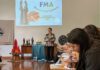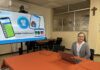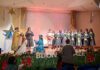

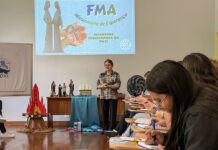
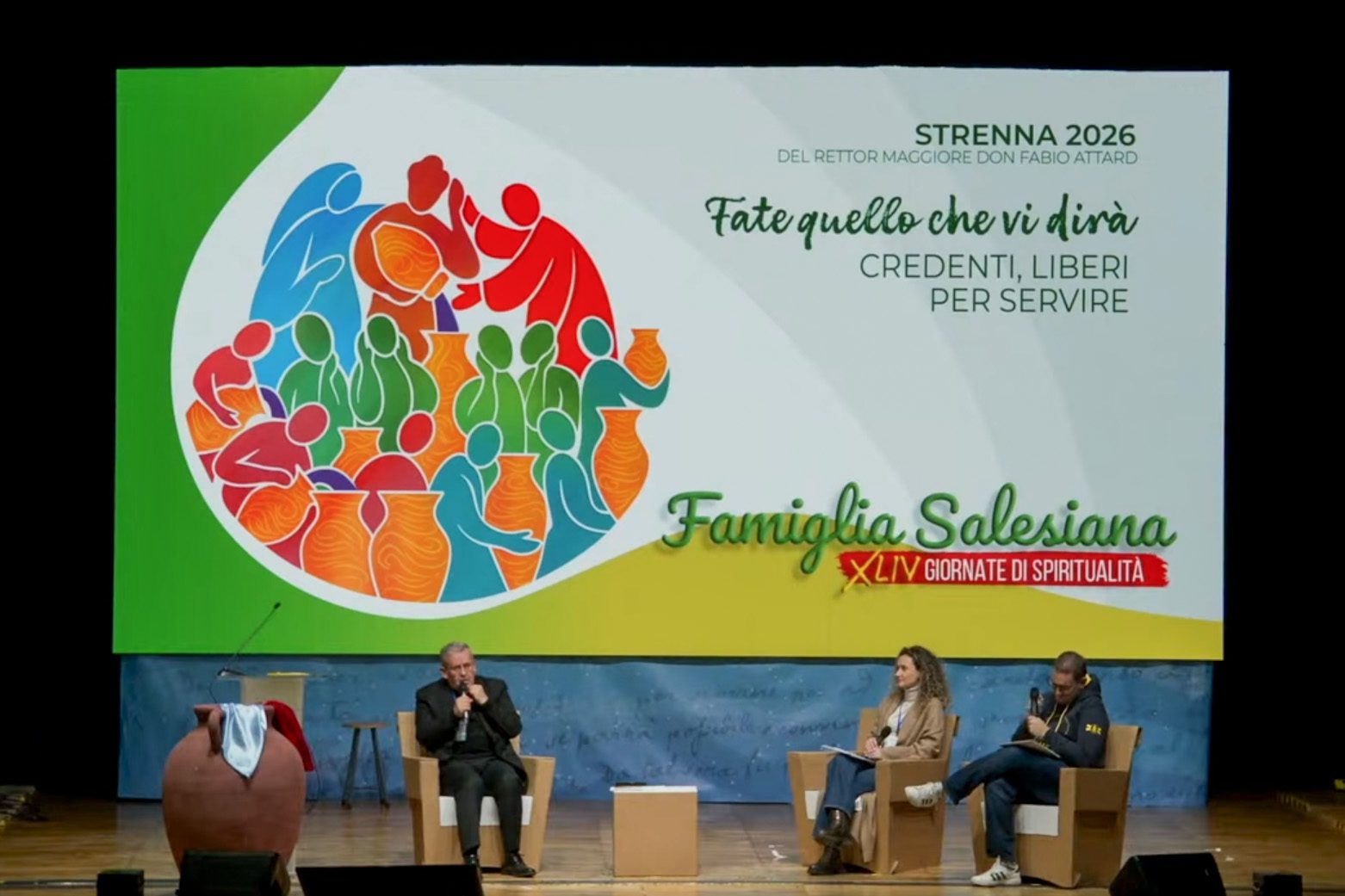
Turin (Italy). On the afternoon of 15 January 2026, the Teatro Grande di Valdocco in Turin welcomed approximately 350 members of the Salesian Family, including Mother Chiara Cazzuola, Sister Leslie Sándigo, Councilor for the Salesian Family, and other General Councilors of the FMA Institute, to launch the traditional Days of Spirituality, now in their 44th edition.
The theme at the heart of the event – Strenna 2026 of the Rector Major, “Do what he tells you. Believers, free to serve” was immediately represented on the stage with gestures and symbols, through an evocative choreography created with joy and enthusiasm by the boys and girls of the Valdocco 1st level Secondary School.
Fr. Leonardo Mancini, Superior of the Italy-Piedmont and Valle d’Aosta (ICP) District, then did the honors, citing the Strenna that Don Bosco offered to the students and artisans of Mirabello on 31 December 1863, asking for their souls – “Da mihi animas cetera tolle” – and promising them “everything that I am and what I have. For you I study, for you I work, for you I live, and for you I am also willing to give my life.” Approaching the 2026 Strenna, Fr. Leonardo commented, “It seems to me that there is no better way to Salesianly describe the expression of the title of the Strenna ‘free to serve’.” And he concluded by wishing “that we welcome these SFSD 2026 as a renewed opportunity to grow in faith – understood as listening to God, in His Word, in young people, and in history – and that our listening can constantly transform into free and joyful service, into a lived Gospel.”
The word then passed to Fr. Joan Lluís Playà, Central Delegate of the Rector Major for the Salesian Family, who presented the program and gave some practical instructions for experiencing the Days as a true and proper “inner journey”.
After the prayer led by the Salesian Novices of Colle Don Bosco International Novitiate, the two presenters –Silvia and Roberto– called on stage the Rector Major, Fr. Fabio Attard, Salesian Family Center of Unity, for an in-depth look at the Strenna, introduced by the video summary presented for the first time in Rome, at the Generalate, on 27 December 2025.
Fr. Fabio motivated the theme and the biblical icon of Cana by placing it in continuity with the jubilee theme of Hope, which is Jesus Christ, whose Person requires trust, entrustment. “If hope is a Person and faith is a relationship, the dynamics, the strength, must come from the Word. This experience of Cana –which started badly– is an invitation first of all to never lose hope and, at the same time, to take root, to put ourselves in the space that helps us to read reality without fear and to support ourselves with the strength of God. In this way, we can encounter reality, not remain neutral spectators, knowing that we only have water, but water in God’s hands changes into wine. This has huge Salesian consequences for all of us” he explained. “This questions about where I am, and together where we are, and this encourages us… but if we are not connected, in contact with Him, we do what we think, which is not always the best solution.”
The Rector Major then specified that the text of Strenna 2026 is organized in four steps, with a reflection for each session and questions, which he suggested resuming in groups, at different times of the year, questioning the local reality and one’s own involvement. “Are we looking at reality, or are we detached? Are we listening to reality in the light of the Word, or are we doing analyses, perhaps intelligent, but which do not move me from my chair? What are the choices?” The servants, while not fully understanding the request, made “the choice to believe in Jesus’ words and acted, not because they understood, but because they believed.”
Responding to some questions collected from different parts of the world, he therefore insisted on the centrality of the relationship with Jesus. “We are generous, but if it is not the fruit of a relationship with Jesus, serving becomes an idol.” What is important is being believers, credible witnesses, according to Salesian identity, having as its objective the integral good of young people. It is a testimony that “overcomes the barriers of religions and cultures, because loving young people is a good for humanity. (…) This is the Don Bosco that we have inherited, that we are called to love, to know, and to witness.”
The participants then went to the Basilica of Mary Help of Christians for the Eucharistic Celebration in memory of Blessed Luigi Variara, presided over by the Rector Major. In his homily, he commented on the leper’s healing, bringing it back to the educational-pastoral level. “Jesus’ gesture, a divine gesture, teaches us that true healing occurs in contact, in relationships, not in protocol, in distance, in polite indifference, but in touch, in listening, in the presence that says without words, ‘I am not afraid of you, your suffering does not pollute me; I would like to give you my compassion’.”
Furthermore, Jesus does not want the leper’s joy to remain private, but sends him back to the community, from which he was excluded. “This is profoundly important for the Salesian Family, because our mission does not aim at spiritual isolation, rather we educate towards reintegration into the ecclesial, community, family, social fabric… healing is a community experience.”
Regarding Jesus’ request for silence, he identified the risk of appropriating God’s grace. “Our mission has only one goal – Don Bosco told us clearly – the glory of God and the salvation of young people. Grace belongs to God and to Him alone. We are poor tools, useless servants.”
Fr. Fabio Attard concluded with an invocation: “May the Lord teach us today the courage to believe, the docility to compassion, the path to community, above all, the inner and spiritual freedom never to appropriate the grace that passes through us, leaving signs of healing and profound humility, so that as believers, we will always be free to serve.”