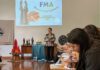


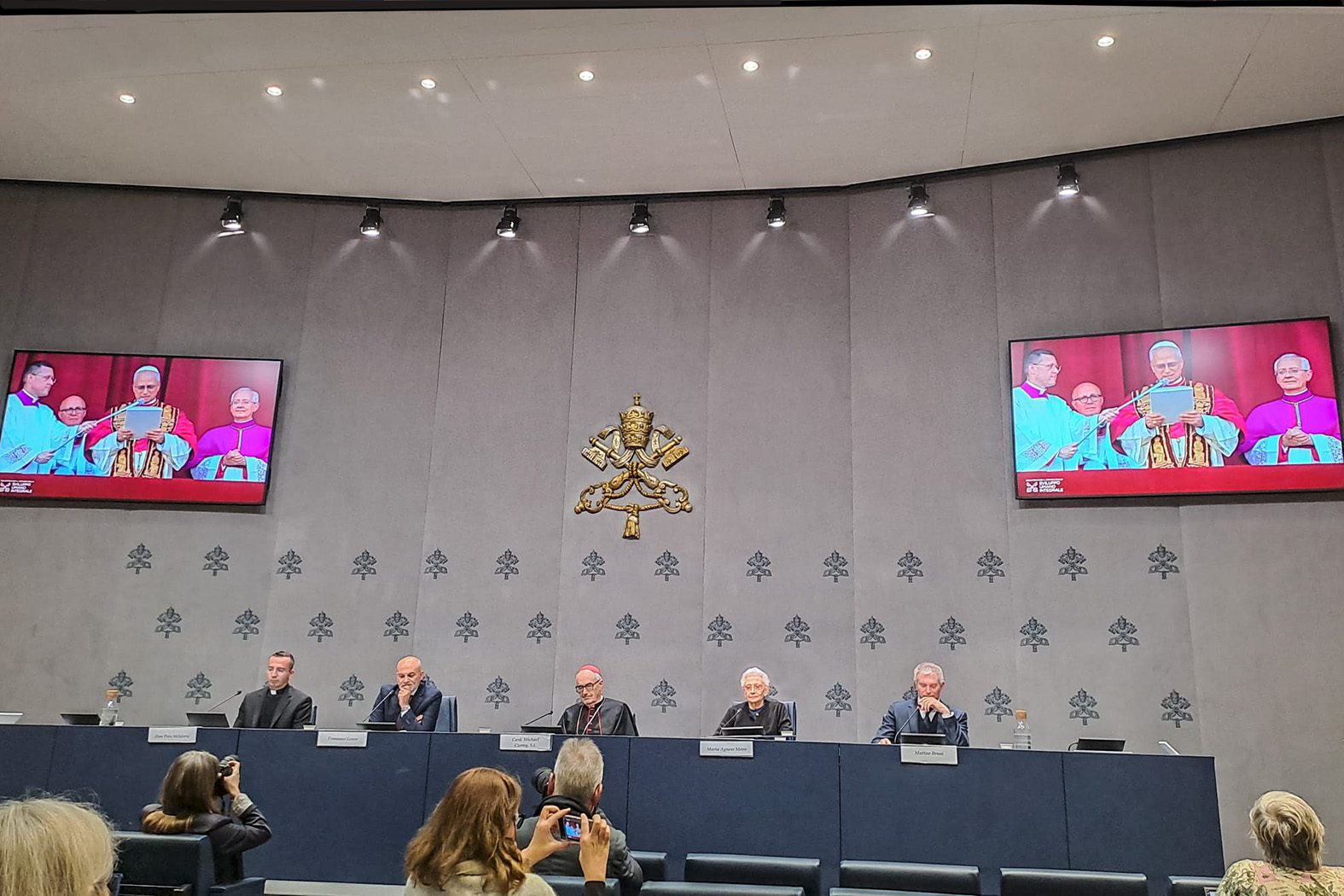
Rome (Italy). On 18 December 2025, the Press Conference presenting Pope Leo XIV’s Message for the 59th World Day of Peace, which is celebrated on 1 January 2026, was held in the Holy See Press Office on the theme, “Peace be with all of you: towards a ‘disarmed and disarming’ peace.”
The director of the Press Office Matteo Bruni defined it, “A long-awaited message, which is greatly needed. In this time of violence, of calls to arms, to power as a solution to conflicts even between people.” The theme recalls the first words spoken “like a program” by the Pope from the Loggia of St. Peter’s Basilica on the day of his election, 8 May 2025, the greeting of the Risen Jesus, “Precious words, for the time we live in, words of hope, like a reading of the world’s thirst for peace in light of the hope that comes to us even from this jubilee year.”
Opening the speeches was Cardinal Michael Czerny, Prefect of the Dicastery for Promoting Integral Human Development, who contextualized the Message as a reflection “which goes far beyond politics or strategy”, but which places peace “in its primary seat, the human heart, regardless of its faith.” The first disarmament to be conducted is then that of one’s own heart, “despite the temptation, in the face of the horror of our bellicosity, to abandon the desire for peace altogether.”
Cardinal Czerny then stated some obstacles to human disarmament, such as technological progress, with the application of artificial intelligence also in the military sphere, the reduction of responsibilities, “which make war increasingly terrible,” and fear.
“Peace exists; it wants to inhabit us. It has the gentle power to illuminate and broaden intelligence; it resists violence and conquers it.” Recalling the words of the Message, the Prefect observed that precisely in the human heart lies that desire for peace which “can overcome our fears and our claims to domination” and which therefore, “if we truly want peace, we must deal with our internal aggression.”
The feeling of humanity present in each one yearns deeply for peace and is a cry that must be heard, especially from those with political and social authority. “The Message calls on everyone to serve life, the common good, and the integral development of people,” he concluded.
Professor Tommaso Greco, full Professor of philosophy of law at the University of Pisa, commenting on the expression, “unarmed and disarming peace” of the Holy Father, underlined the need to first change one’s gaze on reality and not to surrender to an attitude that defines itself “realist” and which, on the contrary, is based on a partial and distorted vision “because it forgets and conceals that part of good, of light, which exists.”
“In this sense,” explains Prof. Greco, “it is not only disarmed because it rejects the logic of weapons, but it is also disarming because it invites us to emerge from that circle in which distrust fuels fear, and fear pushes us towards mutual and unstoppable rearmament.”
The most important gesture that in his opinion the Message invites us to perform is, “to employ peace as the light that guides the path. Not as a horizon, which risks becoming unattainable, but as a precious heritage that we already possess and which therefore must be protected; as ‘a small flame’, which although ‘threatened by the storm’, must be guarded “‘without forgetting the names and stories of those who witnessed it to us’.”
And precisely so as not to forget the names and stories, and to transform them into a guiding light towards a peace that is not artificial, but that touches the heart, leaving an indelible mark and an even stronger desire to have it as a stable horizon, the presentation of the Message made use of two truly touching testimonies.
In my life, I have experienced what the Pope emphasizes, ‘seeing the light and believing in it is necessary to avoid sinking into darkness.’” Fr. Pero Miličević, parish priest at the parish of Saints Luke and Mark the Evangelists in Mostar, Bosnia, thus began the story of his experience “of the darkness and evil of war” which suddenly broke out on 28 July 1993, turning away the “happy childhood of a seven-year-old boy,” when Muslim military units of the Army of Bosnia and Herzegovina attacked their village, sowing death and leading them into captivity for seven months along with 300 Croatian Catholics. From his testimony, very alive and moving, emerges the indispensable strength of faith to endure those atrocities. “We would never have resisted without faith, prayer, and the need for peace. Precisely that education in faith in God nourished us and helped us overcome the horrors we witnessed.”
A peace that “must be experienced, cultivated, and preserved” firsthand, in order to be able to give it to others, in the words of Pope Leo. “If peace is not a reality experienced and to be preserved and cultivated, aggression spreads in domestic and public life.”
Precisely for this reason, twenty years after leaving the place of imprisonment, Fr. Pero feels the need to return there. “The tears flowed, but this helped me find peace again.” And again, for this reason, he decided to tell his story, to “awaken the awareness that evil is overcome with good and forgiveness, not with revenge and weapons.”
The last testimony is that of Maria Agnese Moro, journalist and daughter of Aldo Moro, statesman and former President of the Italian Council of Ministers, kidnapped and killed 55 days later by the Red Brigades terrorist organization on 9 May 1978. Dr. Moro has undertaken and continues with commitment the path of restorative justice, “which the Pope cites in his message as a tool to be supported and increased,” with the capacity she has “to bring humanity back to where dehumanization and its consequences have reigned.”
In her presentation she focuses on the aspect of a language that brings one closer to the other and is an antidote to dehumanization. “The encounter with the pain of the other is the first powerful and irreversible blow to dehumanization. If you feel pain, you are certainly human, you are like me.”
This is what she concretely experienced in meeting the participants in the armed struggle of the ’70s and ’80s, some linked to her father’s story. “Being able to talk to them is painful and beautiful. My every word hurts them, but it recognizes their humanity. (…) Their every word hurts me, but it recognizes my humanity. (…) True listening is a mutual recognition of humanity. In this saying and listening there is all the justice that we and they need to live.”
Her conclusion, “Yes, dear Pope Leo, peace is there and silently works” – and the answers to journalists’ questions, in which he repeatedly invited “to look at this peace in progress”, “at the amount of reconciliation that has been made” and to “train a little the eye to see the good, the good that goes on, that moves,” were together with the testimony of Fr. Pero and the interventions of the other speakers, a true “injection of hope,” increasing the desire to deepen Pope Leo’s Message to walk together “towards an unarmed and disarming peace.”
For further information and dissemination, a video in five languages and an infographic are available on the Dicastery for Promoting Integral Human Development website, as well as texts from the Message and speeches of the Press Conference (link to website).