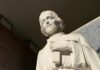

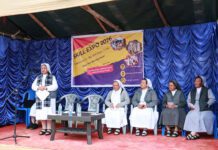


Rome (Italy). On 9 February 2025, the liturgical memory is celebrated of Beata Eusebia Palomino Yenes (1899-1935), Daughter of Mary Help of Christians, beatified by Saint John Paul II on 25 April 2004 in Rome. She too, like Blessed Maria Troncatti, offered her life for peace.
Born in Cantalpino, Spain, on 15 December 1899, into a poor and deeply Christian family, from an early age Eusebia learned to trust Providence, to live by her work, and love others forgetting herself.
In the climate of faith in which she lives, she opens herself gradually to Grace, giving God the first place. Her First Communion, as for many saints, marks a turning point: she understands that she belongs to the Lord. At the age of 12, she goes to Salamanca with her older sister to work for a family. She started attending the festive oratory of the Daughters of Mary Help of Christians and the Sisters offered her work in the community. Eusebia does even the heavy work, never giving up the deep desire to consecrate herself to the Lord.
Finally in 1922, the 50th year of the foundation of the FMA Institute, she started her novitiate and in 1924, she made her first Profession. She is sent to Valverde del Camino, in the extreme south-west of Spain, in the mining zone of Andalusia, towards the border with Portugal.
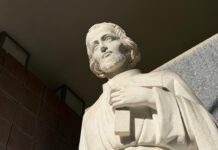
She performs the humblest tasks and assistance to the children of the oratory with admirable dedication. Gradually, she conquers the affection of all and does not lose an opportunity, also through the numerous letters to her family, to invite to faith in the merciful Love of the Lord and to the practice of the Rosary of the Holy Wounds, and to confidence in Mary with the practice of “Marian Slavery” according to the teaching of St. Louis M. Grignion de Montfort.
She, so humble and with little education, follows the events of Spain that, at the beginning of the thirties, lives difficult events that will lead to the Civil War. In July 1930, a revolutionary anti-monarchist movement spread in Spain. On 12 April 1931, the Republicans and Socialists win the elections; King Alfonso XIII leaves for France. The new government also takes measures against religious, including the expulsion of the Jesuits.
The raging climate also reaches Valverde, where Sister Eusebia lives. The community’s animator is the future martyr and Blessed, Sister Carmen Moreno. On 12 May, groups of revolutionaries arrive at the Salesian school and stone doors and windows. The Sisters manage to get to safety by going through the courtyard into the house nearby.
Sister Eusebia writes in a letter to her family, “Spain is Marian; Spain belongs to the Virgin and cannot perish. But there are countries and cities in Spain that do not correspond to these graces…”. And she repeats, “Christian homes must be perfumed by prayer and frequent communion, because from them bloom those enchanting roses of holiness, which are the glory of God, the honesty of the family, and the honor of the Homeland and society. (…) Now, if we want the Virgin to reign in us (…) let us take the holy Rosary; let it resound in our homes and let us raise the Cross of Jesus in our souls with the Rosary of the wounds. It is so short and so easy to pray, and we can bring so many blessings upon our beloved Spain!”
Sister Eusebia translates the desire for peace into still current indications. “If we want Christ to triumph, that Christ reign in all areas of the earth, all these things that we are going through will disappear as the charity towards the poor of Christ grows. Well, if those workers have made a mistake, it is because they found themselves without faith, without God, and without love and for this they rebel seeking that welfare that is only found in religion. At the moment when they will see charity and love, they will turn like meek lambs to God and will be true Christians, giving glory to God and to the Fatherland.”
It is in these days that Sister Eusebia matures the decision to offer herself as a victim. For what purpose? In the Positio super virtutibus, there are some testimonies in which it is stated that she did this for Spain, as a crowning of her commitment to “salvation of souls”, in the wake of Don Bosco’s Da mihi animas cetera tolle.
On 17 May 1932, after having asked the permission of her confessor and the animator, while she was hidden in secular clothes in a house that had given her hospitality, she pronounced the act of offering her life. On 19 May, the situation having improved, the Sisters returned to the school and Sister Eusebia resumed her occupations. In August she suffers the first symptoms of that asthmatic disease which opens up Heaven to her on the night between 9 and 10 February 1935. The offer of her life is accepted.
Oblative value had marked her soul from her girlhood. She tells in her autobiography, “While at school I remember perfectly that there was the Sacred History on the walls. In one of the first days, the teacher explained a picture in front of my desk that contained the story of Isaac. I was sitting there making sticks (rolling up paper) but I liked that explanation very much and did not lose a syllable. The next day, I went with my mother to the nearby forest in search of wood.
She gathered a large bundle of wood and, as was the custom, carried it on her shoulders, with a cord tied to her belt up to her shoulders. She gave me a little one too and I went down from the mountain with great joy and satisfaction, remembering the story of Isaac’s sacrifice, which I had heard my teacher tell me and along the way, I told it to my mother. When I felt tired, I said, “Now let’s rest a little, like Isaac, because we still have a long way to go,” and we rested a bit, then we started going back until we rested again. I said to my mother, “Isaac was a victim; if he died, he would go straight to heaven. I am not a victim, but I would like to be one, if it were pleasing to God, because I feel in my heart a desire so great to make myself holy that I cannot remedy it.” And my mother who advanced under the weight of the bundle, I saw the tears flowing on the face.”
Forty years before the offering of Sister Maria Troncatti’s life, Sister Eusebia had chosen to be an “artisan of peace”, offering her life for her homeland.