







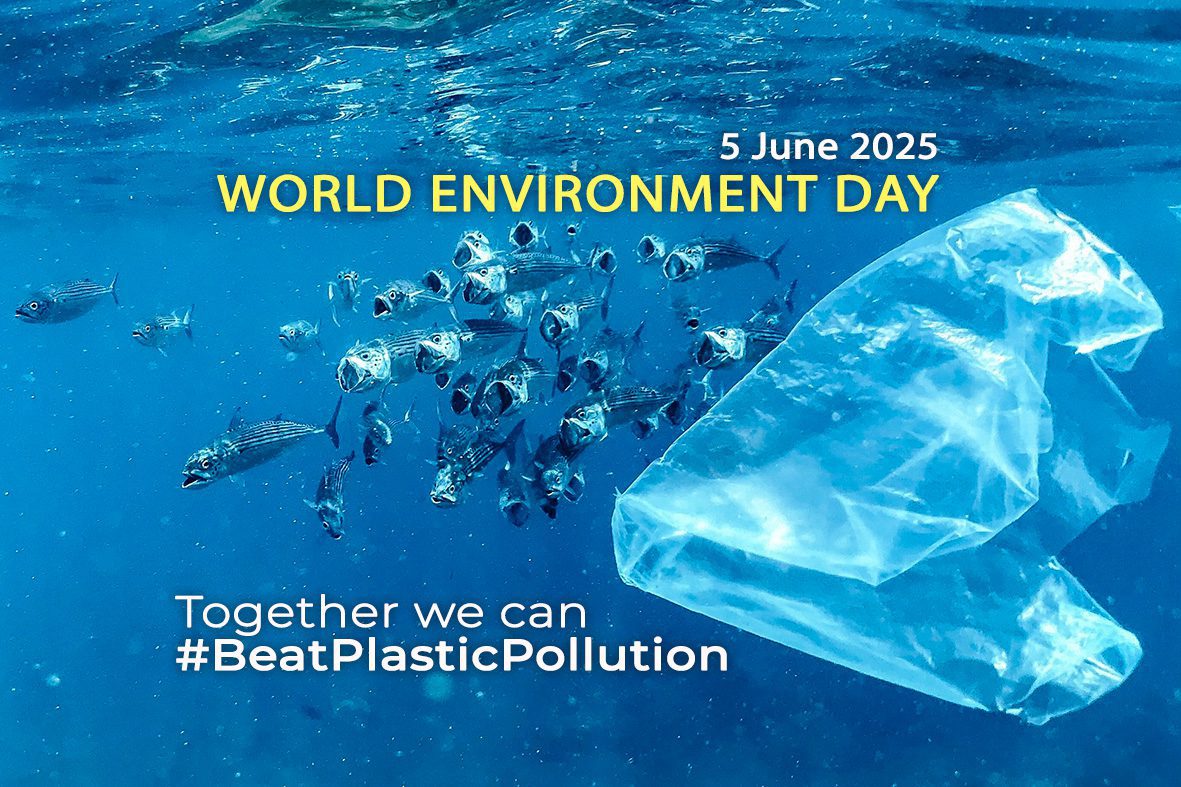
Rome (Italy). World Environment Day, first celebrated in 1973 and promoted by the United Nations Environment Program (UNEP), is celebrated on 5 June 2025, to raise awareness of land protection issues, promoting respect for the planet and a change in mentality and habits.
“Together we can defeat plastic pollution” is this year’s theme, a collective call to action to tackle plastic pollution and push individuals, organizations, industries, and governments to adopt sustainable practices leading to systemic change.
UN Secretary-General, António Guterres, in his Message for Day 2025, outlines the situation, acknowledging the growing commitment but encouraging to speed up processes:
“Plastic pollution is suffocating our planet, damaging ecosystems, well-being, and the climate. Plastic waste clogs rivers, pollutes the oceans, and endangers wildlife. In addition, breaking into ever smaller parts, the plastic infiltrates every corner of the Earth: from the top of Mount Everest to the depths of the ocean, from human brains to maternal breast milk.”
#BeatPlasticPollution is a UNEP campaign to stop the pervasive impact of plastic pollution on people and the health of the planet. The campaign promotes rapid, large-scale, and coordinated action for a cleaner, healthier, and more sustainable future. The activities show the impact of pollution on climate, nature, biodiversity, and health and provide a platform to inspire generative circular economies and enable the transition towards a pollution-free planet.
World Environment Day therefore aims to highlight the growing scientific evidence on the impact of plastic pollution and drive the momentum to reject, reduce, reuse, recycle, and rethink the use of plastics to build a more sustainable future.
The Republic of Korea has been chosen as a country for World Environment Day 2025, with the aim of ending plastic pollution globally.
Freeing the planet from plastic pollution is an important contribution to achieving the Sustainable Development Goals (SDGs), including those related to climate action, sustainable production and consumption, the protection of the seas and oceans, the repair of ecosystems, and the maintenance of biodiversity.
For the Institute of the Daughters of Mary Help of Christians, listening to the cry of the earth is one of the requests of General Chapter XXIV, which invites us to assume integral ecology, the 7 objectives of Laudato si’, and the Global Educative Pact in the style of the Preventive System as a dimension of life and the educative mission, networked with the Salesian Family, institutions, and educative agencies (Acts CGXXIV n.3).
For the Daughters of Mary Help of Christians, it is a call to action in the educative mission to protect and preserve the planet, through various initiatives with the Educating Communities in the realities where they are present, In synergy with the local institutions, and through education against the culture of waste that Pope Francis talks about in the encyclical Laudato si’, on its 10th anniversary:
“Our industrial system, at the end of its cycle of production and consumption, has not developed the capacity to absorb and reuse waste and by-products. We have not yet managed to adopt a circular model of production capable of preserving resources for present and future generations, while limiting as much as possible the use of non-renewable resources, moderating their consumption, maximizing their efficient use, reusing and recycling them. A serious consideration of this issue would be one way of counteracting the throwaway culture which affects the entire planet, but it must be said that only limited progress has been made in this regard.” (LS no.22)







Let’s do it together!
No color,living standard and power difference we can defeat plastic pollution.