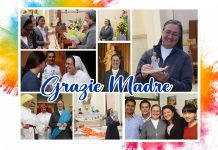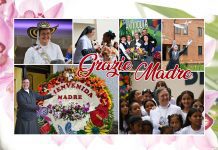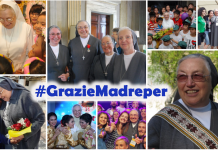

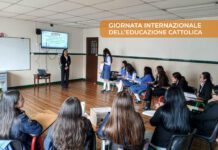
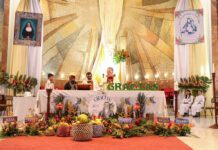
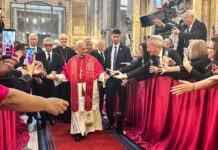
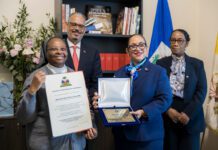
Beirut (Lebanon). From 27 November to 2 December 2025, Pope Leo XIV completed his first apostolic journey in Turkey and Lebanon, a journey that was a sign of fraternity and peace, a call for unity among the Churches and the presence of hope among the people. On the afternoon of 30 November, he landed at Beirut International Airport. On 1 and 2 December, some Daughters of Mary Help of Christians of Jesus Adolescent Province (MOR), with collaborators and young people, were able to participate in various moments of this historic visit.
The paternal embrace of the Church in Harissa
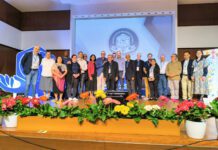
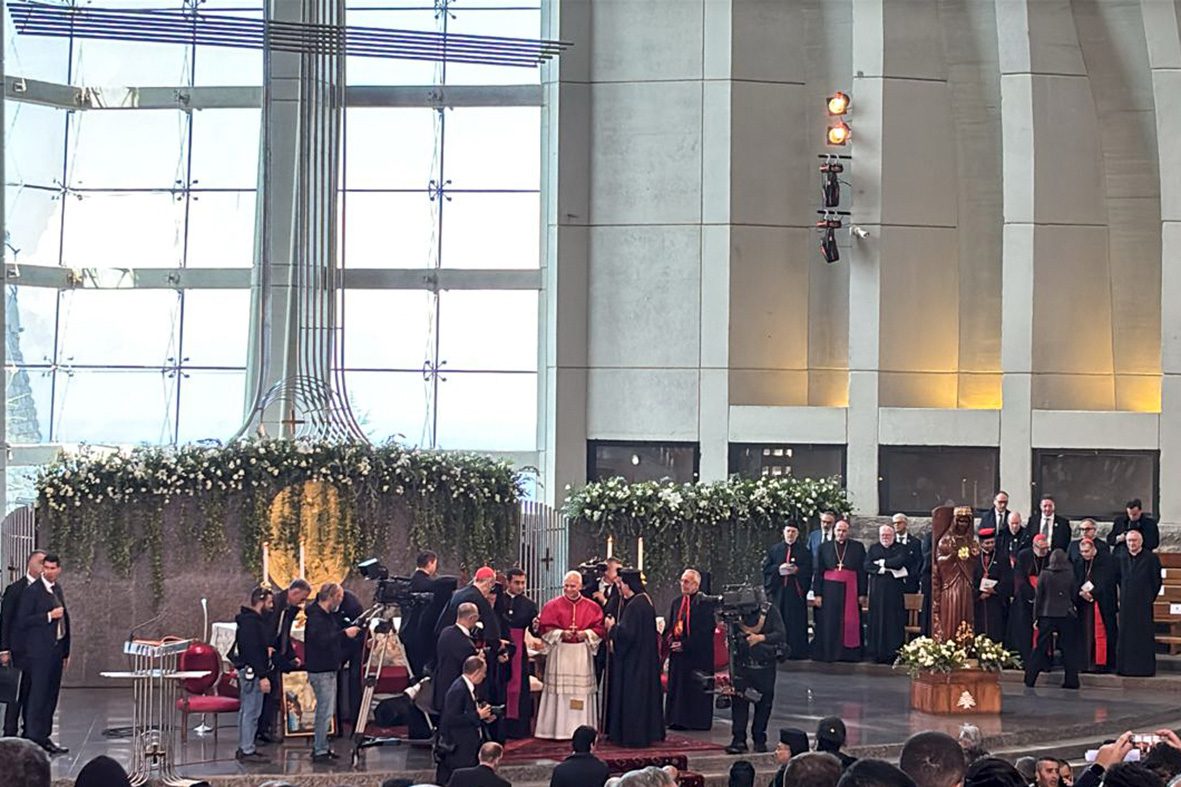
On the morning of 1 December in Harissa, at the Shrine of Our Lady of Lebanon – the most important of the Marian shrines in the Middle East, built in 1904 on the 50th anniversary of the proclamation of the dogma of the Immaculate Conception by Pope Pius IX – Pope Leo met Cardinals, Patriarchs, Bishops, priests, deacons, and a large representation of consecrated men and women, including the FMAs of Lebanon, together with lay collaborators. Among them, Mother General Emerita of the FMA Institute, Sister Yvonne Reungoat, was also present.
The event was unanimously perceived as a strong sign of the Holy Father’s paternal presence and his heartfelt interest in Lebanon and the entire Middle East, as a gesture of closeness and solidarity at a difficult time. The FMAs experienced the meeting with tangible emotion. The atmosphere, charged with faith and hope, has been able to transcend the serious economic and political crisis afflicting the country.
After listening to some testimonies, Pope Leo XIV in his speech emphasized the pressing need for peace, unity, and perseverance in faith and expressed appreciation for the communion in charity that has been built. “From these roots, strong and deep like those of the cedars, love grows and, with God’s help, concrete and lasting works of solidarity come to life.”
Although part of a dense program that included ecumenical meetings and a visit to the tomb of Saint Charbel Makhlouf, the meeting in Harissa had a strong Marian and spiritual connotation, in which the Pope recognized the Shrine as a “sign of unity for all the Lebanese people. It is in being with Mary at the Cross of Jesus that our prayer, an invisible bridge that unites hearts, gives us the strength to continue hoping and working, even when the sound of weapons thunders around us and the very demands of daily life become a challenge.”
Pope Leo also spoke of responsibility towards young people, “Only in this way can we once again hope for tomorrow, despite the harshness of a difficult present to face. (…) It is important to encourage their presence, even in ecclesial structures, appreciating their contribution of novelty and giving them space. And it is necessary, despite the rubble of a world that has its painful failures, to offer them concrete and viable prospects for rebirth and growth for the future.”
Taking up the testimony of Sister Dima, who, faced with the outbreak of violence, chose to keep the school open “making it a place of reception for refugees and an educational center of extraordinary effectiveness.” He also encouraged all those present, “to continue in this praiseworthy work, especially to meet those in need and without means, those who find themselves in extreme situations, with choices marked by the most generous charity, so that the education of the heart is always united with the formation of the mind”. (complete text)
The FMAs and their lay collaborators left the Sanctuary with hearts filled with hope and the renewed strength to continue their mission, supported by the closeness of the Successor of Peter.


Encounter with the young people at Bkerké
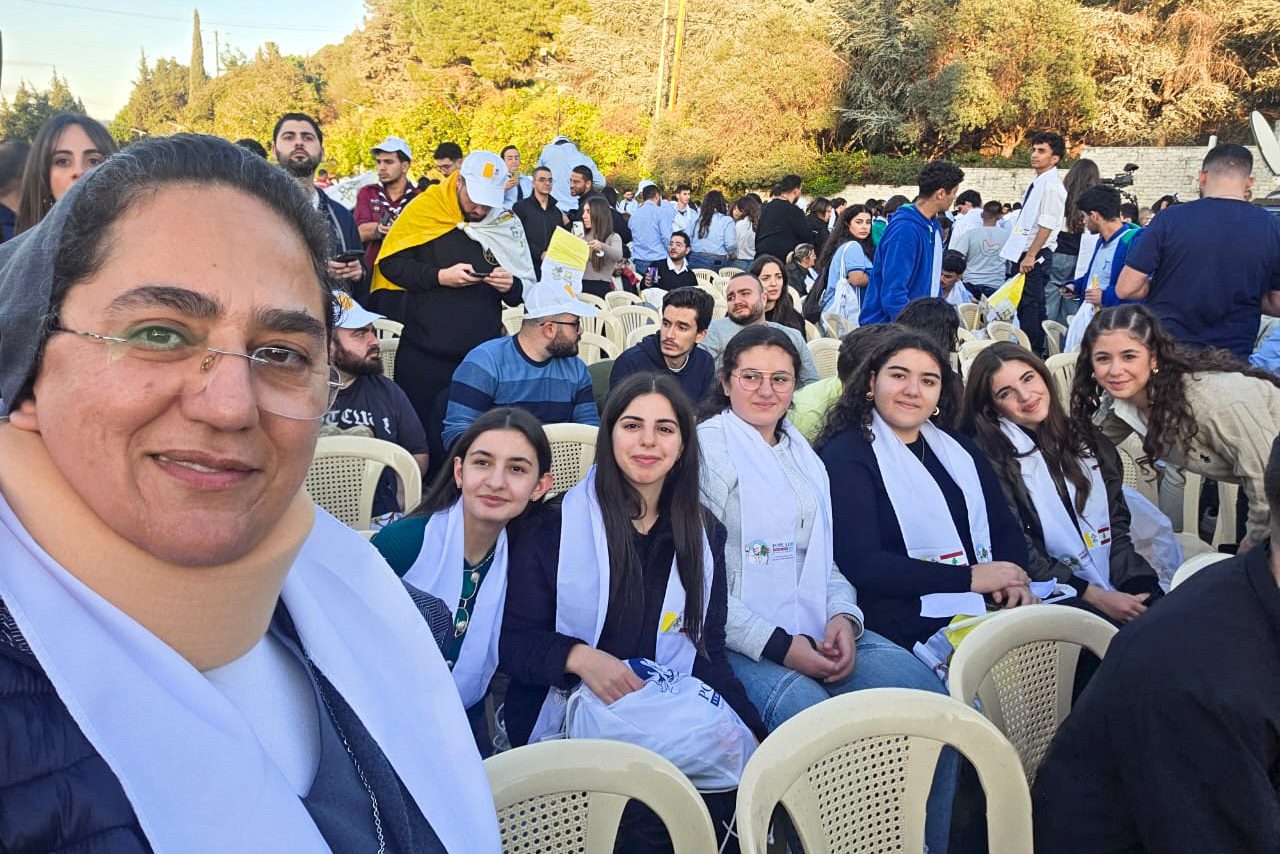
On the evening of 1 December, around 15,000 young people from, not only Lebanon, but also Syria and Iraq, gathered in the square in front of the Maronite Patriarchate of Antioch in Bkerké to meet Pope Leo. The event turned into an icon of hope for the entire region. Among the cheering crowd were FMAs from the Hadath Baalbek Community, with a group of young people.
The initial moment included symbols, gestures, choreography, and touching testimonies, including those of young people who dedicated themselves to service after the explosion of the port of Beirut (4 August 2020). They recounted how, among the rubble, they were “simply human beings helping other human beings”, overcoming every barrier. The songs and prayers that resounded on the hill transformed the Patriarchal See into a sanctuary of joy and determination.
Making his debut with a peace salute – Assalamu lakum! (peace be with you) – Pope Leo XIV, responded to the anxieties of young people who feel they are heirs to a torn world with a message focused on hope as a gift and selfless service as a way out of the crisis. Some points of his discourse:
Hope and Time: “You have hope! And you have the time! You have more time to dream, organize, and do good. You are the present and the future is already being built through your hands! And you have the enthusiasm to change the course of history! True resistance to evil is not evil, but love, capable of healing one’s own wounds, while healing those of others.”
Commitment to the common good: “Your homeland, Lebanon, will flourish again as beautiful and vigorous as the cedar, a symbol of the unity and fruitfulness of the people. You know well that the strength of cedar is in the roots, which are normally the same size as the branches. (…) Draw from the good roots of the commitment of those who serve society and do not ‘use’ it for their own interests. With a generous commitment to justice, design together a future of peace and development. Be the lifeblood of hope the country awaits!”
Christ, the fixed point: “You asked me where to find the solid foundation to persevere in our commitment to peace. Dearest, this fixed point cannot be an idea, a contract or a moral principle. The true principle of new life is hope from above; it is Christ!”
The power of love: “What is it that expresses God’s presence in the world more than anything? Love, charity! Charity speaks a universal language, because it speaks to every human heart. (…) True renewal, which a young heart desires, begins with daily gestures, from welcoming the near and the distant, from reaching out to the friend and the refugee, from the difficult but dutiful forgiveness of the enemy.”
The encounter concluded with the young people being entrusted to the protection of Mary, Our Lady of Lebanon. “Many young people always carry the Rosary beads with them in their pockets, on their wrist or neck. How beautiful it is to look at Jesus with the eyes of Mary’s heart! Even from here, where we are right now, how sweet it is to lift our gaze to Our Lady of Lebanon, with hope and trust!”. (complete text)



Holy Mass at Beirut Waterfront
On the last day of his visit, before the solemn Eucharistic Celebration, Pope Leo stopped in silent prayer in front of the monument to the tragic explosion that killed over 240 people. Before leaving the altar, he made a gesture of great humanity. He met the survivors and the families of the victims, greeting them personally and offering comfort and prayer. The emotion was palpable, especially in the FMA group, who saw the Holy Father tenderly embrace the teacher of their Kartaba School, torn by grief at having lost her son, her only brother, and her brother-in-law’s son in that tragedy. This gesture highlighted the Pope’s fundamental mission; to bring Christ’s consolation precisely where the pain is strongest.
A sign from heaven
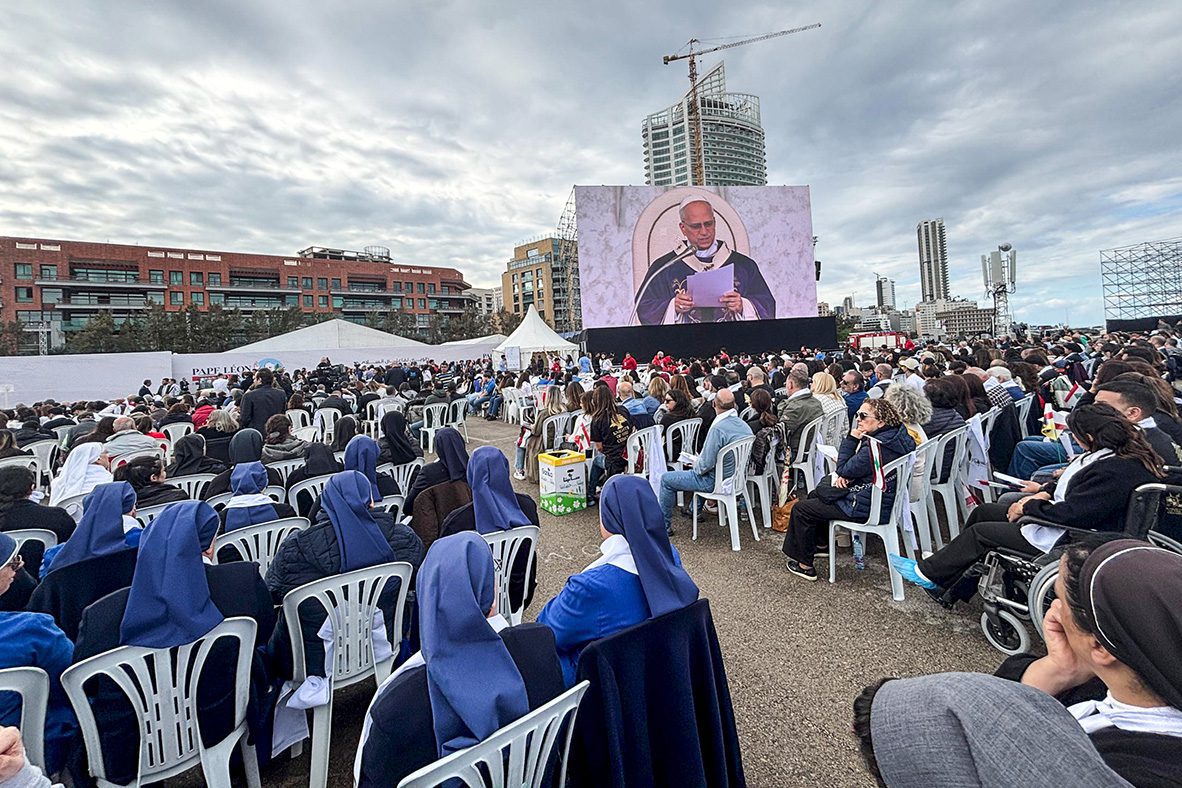
As the many pilgrims gathered on the esplanade of the Beirut Waterfront, a rainbow crossed the sky, symbolically positioning itself as a bridge of peace. Throughout the celebration, the high clouds created a singular natural protection, acting as a providential “umbrella” against the sun. This sign of divine tenderness dissolved as soon as the Pontiff imparted the final blessing, allowing the sun to shine on a multitude renewed in faith.
Among the thousands of people, the FMAs participated with their middle school students and a significant group of young people from Syria.
In his homily, delivered in front of the sea, the Pope reiterated his concluding appeal. He called on the Lebanese not to resign themselves to disenchantment, but to find “shining little lights in the middle of the night, both to open ourselves to gratitude and to spur us to common commitment to this land.”
The Pope urged the nation to rise again, recalling that Lebanon is called to be, not just a nation, but a “message”:
“Everyone must do their part and we must all join forces so that this land can return to its splendor. And we have only one way to do it. Let us disarm our hearts; let the armor of our ethnic and political closures fall; let us open our religious confessions to mutual encounter. Let us awaken in our innermost being the dream of a united Lebanon, where peace and justice triumph, where everyone can recognize themselves as brothers and sisters and where, finally, what the prophet Isaiah describes to us can be realized, ‘The wolf will dwell with the lamb, the leopard will lie down next to the kid, the calf and the little lion will feed together’.” (Is 11:6)
“This is the dream entrusted to you; it is what the God of peace puts in your hands. Lebanon, get up! Be a house of justice and fraternity! Be a prophecy of peace for all the Levant (East)!”
“In these days, with my first Apostolic Journey, undertaken during the Jubilee Year, I have longed to make myself a pilgrim of hope to the Middle East, imploring from God the gift of peace for this beloved land, marked by instability, war, and suffering. Dear Christians of the Levant, when the results of your peace efforts are slow in coming, I invite you to look up to the Lord who is coming! We look to Him with hope and courage, inviting everyone to walk the path of coexistence, fraternity, and peace. Be peacebuilders, peace proclaimers, peace witnesses!
The Middle East needs new attitudes, to reject the logic of revenge and violence, to overcome political, social, and religious divisions, to open new chapters under the banner of reconciliation and peace. The path of mutual hostility and destruction in the horror of war has been traveled too long, with the deplorable results being there for all to see. We need to change our path; we need to educate our hearts to peace. (Complete text)