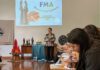

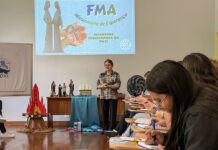
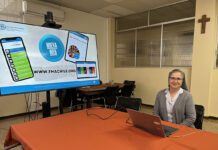
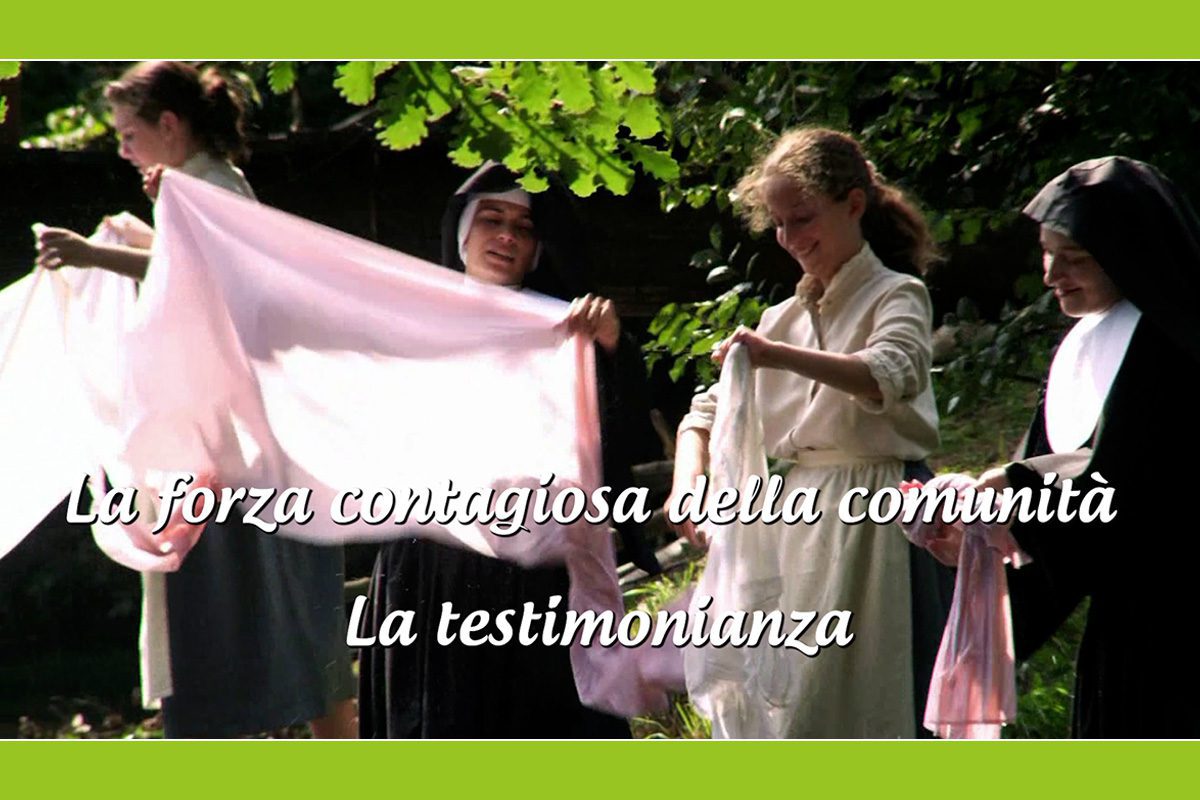
Rome (Italy). On Sunday 9 April 2026, the fourth meeting of the Online Pilgrimage of the Missionary Spirituality Project (PEM) took place, organized by the Missions Sector of the Institute of the Daughters of Mary Help of Christians in collaboration with the PEM Team, focusing on the sites in the Americas where the first FMA arrived in 1877.
The journey, comprising eight stages, is situated within the Triennium of preparation for the 150th anniversary of the First Missionary Expedition (2024–2027), under the theme “Now is the Time to Rekindle the Fire—150th Anniversary of FMA Missions,” with the objective of “celebrating with a grateful heart the missionary ardor of the Institute, in order to rekindle in the present day the prophetic impetus of our charism as a gift to the Church and to humanity” (Circular No. 1038).
In the three previous meetings, presentations were given on Villa Colón – Las Piedras in Uruguay; followed by Almagro – La Boca; and Northern Patagonia: Fortín, Carmen de Patagonia, and Viedma. While on 19 April, the focus was to highlight the contagious vitality of a community of missionaries in Junín de los Andes, whose powerful witness serves as an inspiration, awakening desires for holiness that have blossomed in the youth of Patagonia: Blessed Laura Vicuña and Blessed Ceferino Namuncurá.
The city of Junín de los Andes is situated at an elevation of 780 meters above sea level, amidst lakes and mountains in the southwest of the province of Neuquén. At the time of the arrival of the first Salesians led by Father Domenico Milanesio in 1892, the village numbered just over 400 inhabitants. A portion of the building constructed in Junín by the Salesians was reserved for the Community of the Daughters of Mary Help of Christians, a group Father Milanesio had requested from the Chilean Province, as the Viedma Preprovince was located much further away and the journey would have been too arduous.
On 28 November 1897, the Salesian departed for Santiago, Chile, to meet them. It was not until 29 January 1899, after many vicissitudes and a long, arduous nine-month journey across the Cordillera that Sister Angela Piai, Sister Rosa Azócar, and the young postulant Carmen Opazo arrived in Junín de los Andes to take charge of the domestic chores, cooking, and laundry, as well as a small boarding school and day school for the poorest girls, particularly the indigenous girls of the region.
With great dignity, the FMA Community overcame the numerous difficulties and uncertainties that their isolated life far from any urban center and lacking the resources to meet even basic needs imposed upon them at the outset of their mission in Junín. The community succeeded in creating a warm, family-like environment for many desperate girls and women in need of protection in those remote mountain lands. It was in this place where much was lacking, yet nothing was wanting for one who aspired to holiness, that the heroic sanctity of Laura Vicuña Pino would come to maturity. She, together with her sister Amanda, was welcomed into the community the year following the founding of the College.
Sister Ruth del Pilar Mora, General Councilor for the Missions, in her opening greeting, urged all participants in the Pilgrimage to reflect on witness, the contagious power of community:
It is precisely within such an educational environment, rich in authentic relationships, faith lived with simplicity, and concrete love, that luminous experiences of youthful and missionary holiness blossomed. Let us think of Laura Vicuña and Zefferino Namuncurá. Their holiness did not stem from extraordinary gestures, but from an educational context capable of transmitting the Gospel through life itself, environments where one breathed deep human values and a simple faith, borne witness to by educators and communities who lived what they proclaimed.
The witness of the Salesian environment prepared the ground so that the seed of grace could grow. It was there that Laura learned to give her life with love. It was there that Zefferino nurtured the desire to follow Jesus with a pure heart and a missionary spirit. For them, the community served as a place of accompaniment, discernment, and attainable holiness.
The Councilor concluded with this wish: “that each of our educational communities may rediscover itself as a place of missionary witness, where love lived together becomes proclamation, and communion transforms into a contagious force. May our way of living together continue to prepare the hearts of many young people and families for their encounter with the Lord, and to generate, even today, paths of daily holiness. A blessed missionary journey to all.”
The event—animated by the Sisters of the Mission Sector, members of the Global Missio Team, and Sisters from the Commission for the 150th Anniversary of the First Missionary Expedition and the PEM Team—was attended by various Educating Communities from every continent, who felt a vibrant desire to be missionary communities, credible witnesses that the Gospel gives meaning and flavor to every human life, regardless of any circumstance.
The PEM Online Pilgrimage will continue in October, concluding at the end of November 2026.