
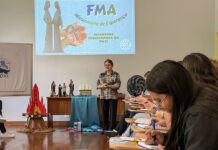


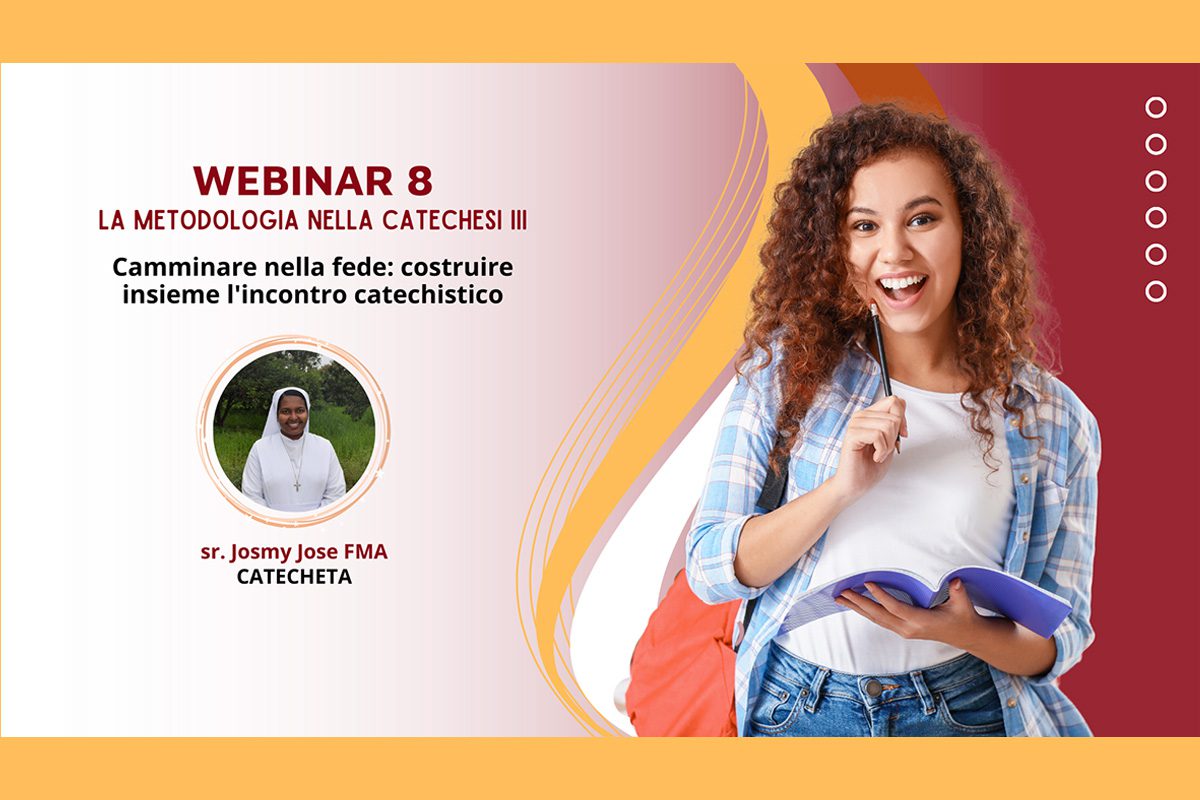
Rome (Italy). From 9 to 15 March 2026, the 8th installment of the webinar series dedicated to the ongoing formation of catechists promoted by the FMA International Commission for Catechesis took place in five languages, addressing the theme, “Walking in Faith: Building the Catechetical Encounter Together.” Integrated into the Catechetical Methodology III course, the program offered participants a clear and in-depth operational framework for structuring a catechetical encounter.
Illuminating this journey was the celebrated account from the Acts of the Apostles featuring Philip and the Ethiopian eunuch (Acts 8:26–40). As this passage suggests, catechesis is not an abstract transmission of content, but a dynamic “arise and go”, a “drawing near to the chariot” of the other in order to walk together in discovery of the mystery of Christ. The webinar proposed two questions for the personal reflection of every catechist. “Arise and go…” (v. 26) prompting them to ask themselves how they feel called today to set out toward the children and young people whom the Lord entrusts to them, and what fears or resistances they must leave behind in order to set forth with confidence in the Spirit; and “Draw near to that chariot” (v. 29) inviting them to reflect on what it concretely means to draw near to their “chariot”, that is, to their daily lives, their language, and their most authentic questions.
The Directory for Catechesis defines every catechetical encounter as “an event of grace: word, experience, relationship, and celebration converge in the mystery of Christ” (No. 213). To bring about this convergence, the webinar proposed a dynamic structure articulated in five fundamental moments, conceived not as a rigid sequence, but as a pedagogical and experiential logic that accompanies the individual from initial welcome to commitment in daily life.
The encounter begins with the recognition of the dignity and uniqueness of every participant. It is not merely a formal greeting, but an authentic welcome that fosters an atmosphere of trust. The connection with daily life, its questions, joys, struggles, and the events of the week becomes the soil in which the Word can take root, in keeping with the teaching of the Directory that, “catechesis starts from life and returns to life” (no. 166).
At the heart of the encounter lies the listening to Sacred Scripture, the “soul of catechesis” (No. 106). It is not merely an informative reading, but an event of revelation. God speaks today, here, to these specific individuals. Through prayerful listening, accompanied by silence and questions aimed at understanding, the catechist helps the participants enter into the text, allowing themselves to be challenged and transformed. This phase may incorporate adapted Lectio Divina techniques, dramatization, or creative rewriting, while always maintaining the centrality of the Word as a living Word that brings about conversion.
What has been heard is embodied through a concrete experience. The Directory values the “way of beauty” and “symbolic language” (no. 213), recognizing that faith is also transmitted through gestures, images, and creative activities that engage the body, mind, and heart. Workshop-based activity is not entertainment, but rather a pedagogical mediation for deep and lasting learning. The symbol, whether gesture, image, or object becomes the language of faith, enabling the expression of realities that transcend words.
Every encounter culminates in a moment of prayer that gathers what has been experienced and entrusts it back to the Lord. “Catechesis and liturgy are inseparable” (no. 80): a hymn, an invocation, or a symbolic gesture, such as lighting a candle or a procession with the Bible, foster a dialogue with God and opens the way to full participation in the sacramental life. Whenever possible, this moment may take on a more structured form, featuring simple yet carefully crafted ritual elements that anticipate and prepare for the Eucharistic celebration.
The encounter does not end with the dismissal, rather, it extends into daily life through a concrete commitment for the week ahead. It is not a generic task, but a specific and practicable action, a gesture of forgiveness, a word of gratitude, a moment of personal prayer, a small act of service within the family that translates faith into daily choices. As the Directory reminds us, “every baptized person is called to be a witness” (no. 56).
During the webinar, two best practices for catechetical sessions were presented and explored in depth. The first is the practice of active listening during the welcoming phase: dedicating the first 10–15 minutes to genuinely listening to each participant, addressing them by name, acknowledging their shared experiences, and valuing every contribution in order to foster the climate of trust essential for receiving the Word. The second is the “Faith Notebook” as a tool for continuity and personalization; a personal notebook in which, at the end of each session,
the catechumen can, using their own words, write down what resonated with them, draw a symbol, record a personal commitment, and, in the following week, reflect upon how they lived out that experience. This tool facilitates internalization, establishes continuity between sessions, offers parents an opportunity for dialogue with their children regarding their faith, and builds a memory of the spiritual journey that the catechumen can read again over time.
The quality of a catechetical encounter depends on the catechist’s ability, like Philip, to become an attentive listener of the Spirit and an authentic traveling companion. It is not enough to prepare engaging activities or to explain doctrine accurately. Rather, it is necessary to create the conditions in which an encounter with Christ can truly take place, allowing the Word of God to speak directly to the concrete lives of those being catechized and to translate into their daily choices.
This is an ever-present challenge, one that the FMA International Catechesis Commission embraces in order to offer its contribution to the growth of all communities of the Daughters of Mary Help of Christians. To this end, the formation program will continue with upcoming encounters scheduled for 12–15 December 2026. Specific dates for each language group will be announced shortly via the Youth Ministry social media channels.