




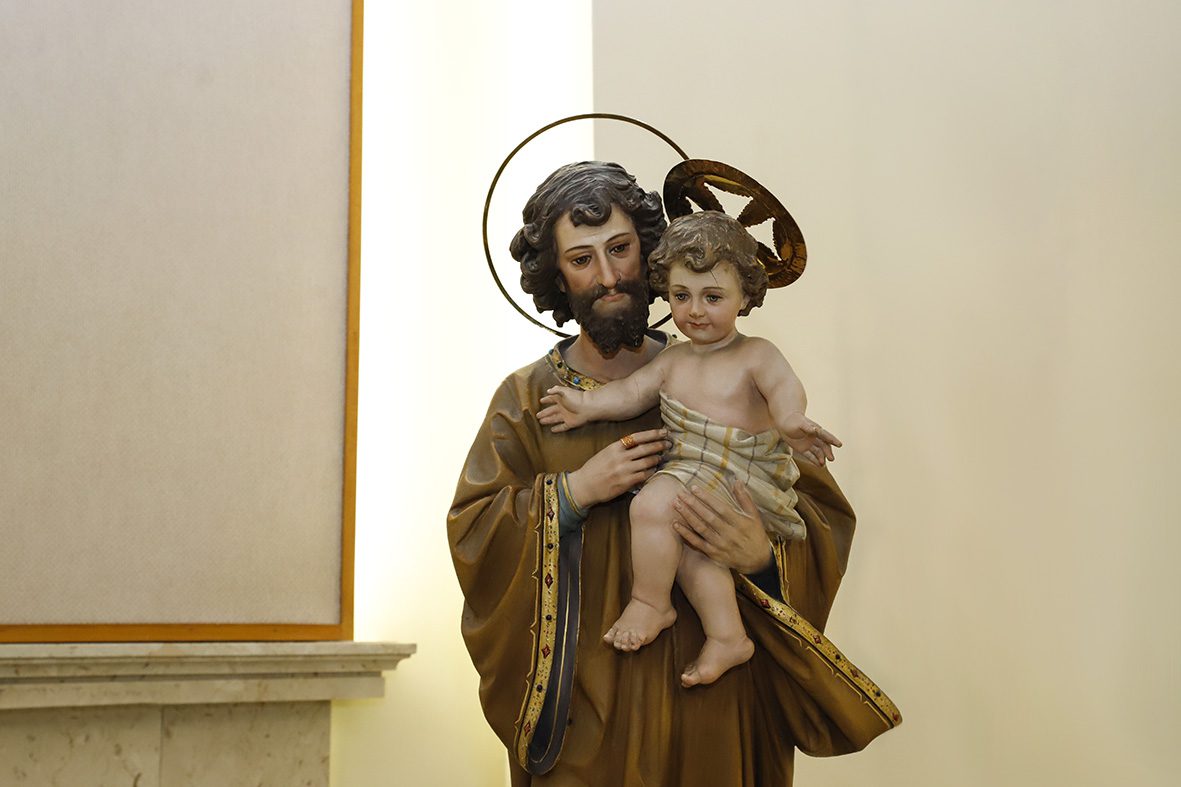
Rome (Italy). 19 March 2026, the Solemnity of Saint Joseph, also marks the patronal feast for the Institute of the Daughters of Mary Help of Christians. In the community of Mornese, he was regarded as a paternal and reliable presence to whom one could turn in every difficult circumstance.
In 1872, the Cronistoria recounts, “Postulants arrive from Turin and elsewhere, arrivals that ought to gladden the heart; and indeed, they do. But… they, too, are all poor; consequently, the staff increases while the means of subsistence diminish. The only secure source of income lies in trust in Mary Help of Christians, in that ever-more-beloved ‘steward’ Saint Joseph, and in the virtue and sustaining word of Don Bosco.” (Cron. II, 14)
And in 1875, we read, “On this very day, the 10th [of March], the novena to Saint Joseph begins; Mother advises the community to observe it with great fervor in order to obtain two graces, the recovery, if possible, of the good Sister Rosa Mazzarello, who is so gravely ill; and that the provident Saint Joseph, by accepting the office of Bursar of the Institute, might help to pay off its debts, which are growing heavier day by day.” (Cron. II, 128)
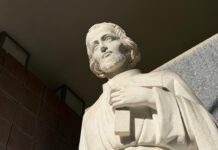
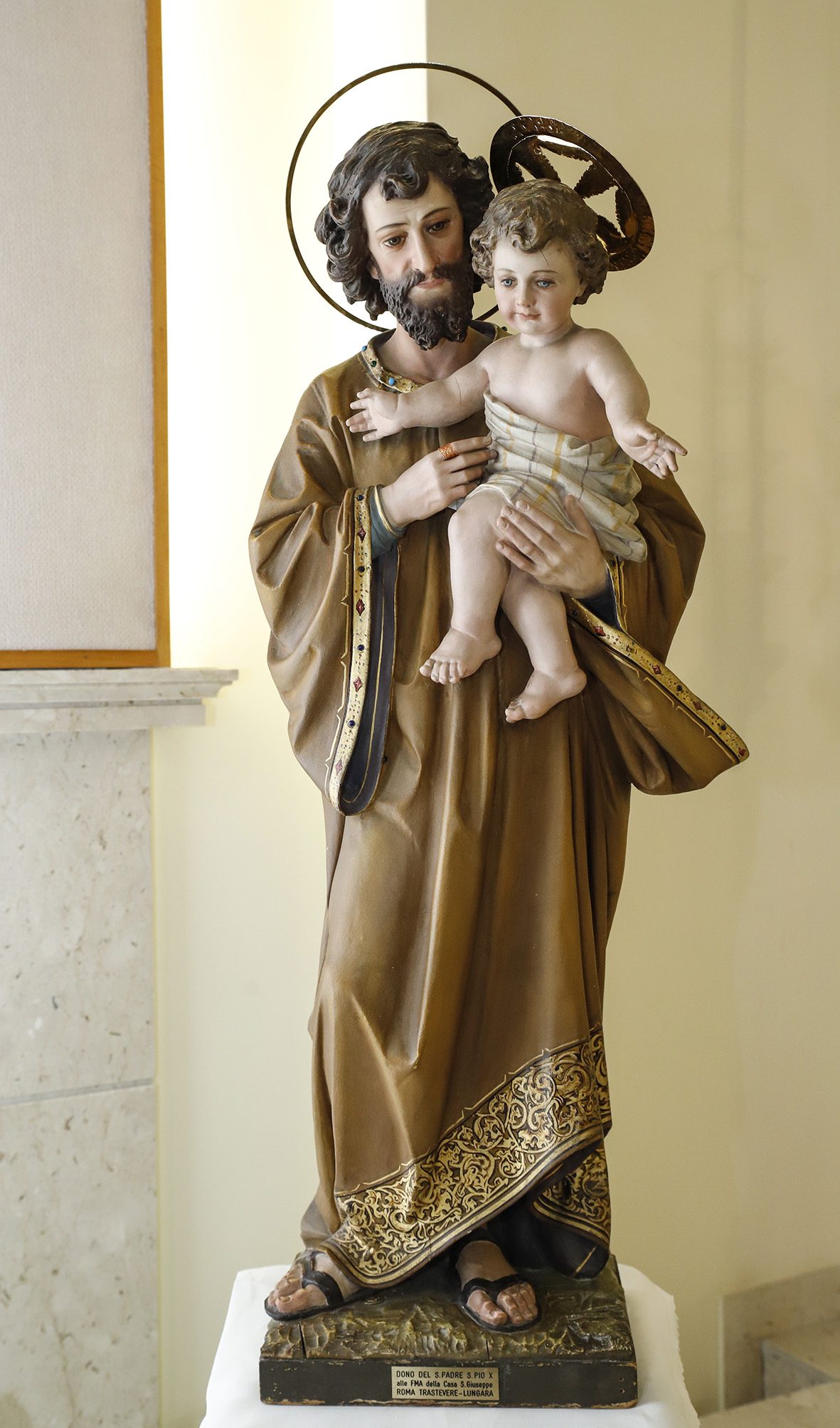
Saint Joseph is designated as the “steward” to whom the Sisters, amidst a perpetual lack of financial resources, would turn with confidence. Although references to this figure in the Gospels are very sparse, and he does not utter a single word, the Church has perceived him as a protector and guardian, precisely as he was to Jesus and Mary.
Mother Daghero, in the final Circular she wrote before her death, she urged, “We shall also do our utmost to pay special honor to dear Saint Joseph during the month dedicated to him. A daily spiritual offering, which we shall also propose to our students, and which we shall strive to practice with fidelity and precision, will keep us in communion with the holy Patron of the Universal Church and of religious families throughout the entire month. He will teach us to live with Jesus in the silence, recollection, and labor of the House of Nazareth, where the days pass filled with hidden joys and holy deeds.” (No. 90, 24 February 1924)
Mother Luisa Vaschetti, serving as Superior General from 1924 to 1943, succeeding Mother Daghero, she highlights another quality of the Saint, “We are in the beautiful month of Saint Joseph. I believe that all the Saints demonstrate a special interest in vocations, given that each of them followed their own path, even at the cost of great sacrifices. Yet Saint Joseph has the additional task of removing, with his master’s plane, any knots or rough edges that might be present in young women aspiring to the religious life; in doing so, he enables them to be better understood and facilitates their formation, matters of essential importance. Let us also pray to this dear Saint for our own particular needs, and above all, that he may obtain for us a blessed encounter with Jesus and Mary at the hour of our death.” (Circ. 134, 24 February 1931)
Saint Joseph was also the guardian of Jesus’ messianic vocation, silently embracing those mysterious questions of His, “Why were you looking for me? Did you not know that I must be about my Father’s business?” (Lk 2:49). As the guardian of the interior life, Saint Joseph is invoked to prepare one for a “good death.” Like a good father, he serves as a sure guide for living this final passage as a vocation to life in its fullness.
Mother Linda Lucotti,
Serving as Superior General from 1943 to 1957, and writing in Circular No. 274 on 24 February 1944, while displaced in Casanova di Carmagnola due to the Second World War, she reminds us that “our Holy Father Don Bosco leads us to the school of St. Joseph. At this school, let us also learn the practice of humility, of which the dear Saint was an unsurpassed model.” In light of the global situation, she suggests emulating the Saint in charity, “Furthermore, in honor of this great Saint, who spent his entire life in the humble station of a laborer, I would like to invite you all to dedicate yourselves with love and generosity to whatever works of charity may present themselves for the benefit of the working class, or indeed, of the poor and the disadvantaged. The spiritual, moral, and material miseries of this sorrowful period we are traversing are many; therefore, whenever a good work presents itself to be done, and lies within our means, let us perform it generously, with the very charity of Our Lord; in doing so, we may be certain that we are performing a work pleasing also to our Holy Father Don Bosco, whose heart was always open to every spiritual and material misery.”
In the teachings of Mother Angela Vespa, Superior General from 1958 to 1969, it is often emphasized that, “silence unites us to God, to the life of the Holy Family, to the life of the Most Holy Mary, of Saint Joseph, and of the Blessed Jesus in His sorrowful Passion, in His agony, and in the hiddenness of the holy Tabernacle, and helps us to translate into life our promises to strive for perfection.” (Circ. 423, 24 March 1959) Guardian of the interior life, Saint Joseph watches over our fidelity to our resolutions, inspiring the fulfillment of God’s will.
Several years later, in Circular No. 719 dated 24 March 1990; while speaking of the upcoming 19th General Chapter, Mother Marinella Castagno placed it under the “special protection” of Saint Joseph, ‘the just man.’ She explained her reasons. “First and foremost, it seems important to me to rediscover the figure of this Saint, Patron of the Universal Church and of our Institute, in order to delve into his faith, his interiority, his industriousness, and his openness to mission. Qualities that must characterize every Christian, and in particular, every consecrated person. […] His figure can shed light upon the distinctive traits of educators that we ought to possess in order to collaborate fully with the family or, in certain cases (which, unfortunately, are becoming increasingly frequent), to stand in its stead and strive to help rebuild it. […] It serves as a call to reflect upon our presence as educators of young women within the current socio-ecclesial context, keeping in mind ‘the Saint’s humble, mature manner of serving and participating in the economy of salvation’ (RC 1).”
In recent times, Pope Francis has observed, “Everyone can find in Saint Joseph, the man who goes unnoticed, the man of daily presence, of a discreet and hidden presence, an intercessor, a support, and a guide in moments of difficulty. He reminds us that all those who remain apparently hidden or in the ‘background’ play an unparalleled leading role in the history of salvation. The world needs such men and women: men and women in the background, yet who sustain the unfolding of our lives—of each one of us—and who, through prayer, example, and teaching, support us on the journey of life.” (General Audience, 24 November 2021).
Just as in Mornese back then, so too today, the Saints can be felt as familiar presences, making faith a force capable of connecting earth to heaven.