
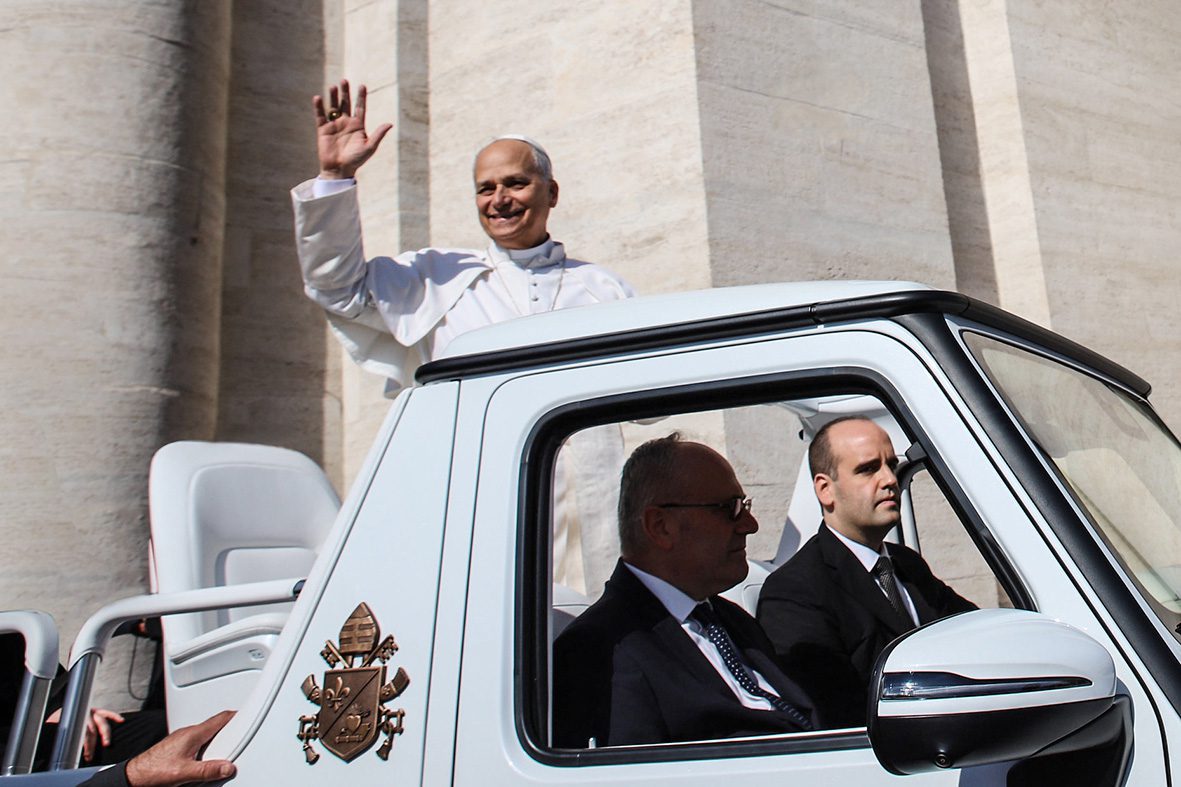
Rome (Italy). From 27 November to 2 December 2025, Pope Leo XIV makes his first apostolic trip to Turkey and Lebanon, taking up the wish of his predecessor, Pope Francis, on the 1700th anniversary of the First Council of Nicaea (325), and above all to strengthen interreligious dialogue and bring hope to a region marked by conflict.
To the journalists accompanying him on the papal plane that left Rome on 27 November, Pope Leo explained the motivations and emotions of this first itinerary outside the borders of the Vatican and Italy:
“This trip to Turkey and Lebanon has, as you know, first and foremost the very meaning of unity celebrating the 1700th anniversary of the Council of Nicaea. And I have awaited this journey with great trepidation for what it means for all Christians. But it is also a great message for the whole world and, in particular, with my presence, that of the Church, of the believers both in Turkey and in Lebanon.
We also hope to announce, convey, and proclaim how important peace is throughout the world. And to invite all people to come together to seek greater unity, greater harmony, and to seek ways in which all men and women can truly be brothers and sisters. Despite differences, despite different religions, despite different beliefs, we are all brothers and sisters, and we hope to be able to help promote peace and unity throughout the world.”
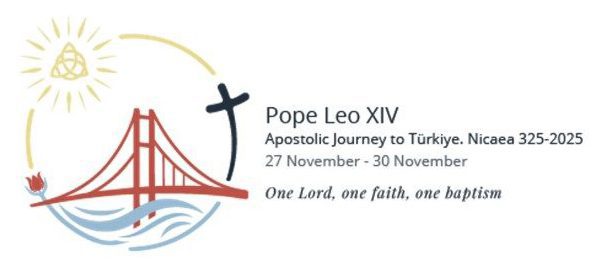
“One Lord, one faith, one baptism” (Eph 4:5) is the motto of the logo of the trip to Turkey, which develops in a circle enclosing the Bridge of the Dardanelles, alluding to the encounter between Asia and Europe, and to Christ as a bridge between God and humanity. Waves flow beneath the bridge, evoking the baptismal water and Lake Iznik; to the right stands the Jubilee Cross 2025, while to the upper left three intertwined circles represent the Holy Trinity. The circle symbolizes the uniqueness of God; the bridge the only faith that unites peoples; the waves the baptism that regenerates the children of God, inviting us to build fraternity and dialogue between East and West.
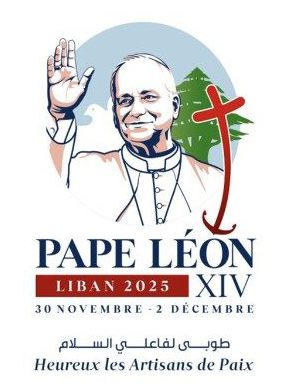
“Blessed are the peacemakers,” from the Gospel of Matthew, is the motto of the Lebanese logo, which depicts the Pope with his right hand raised in blessing, flanked by a dove symbolizing peace, and a cedar representing Lebanon with its rich history of faith and interreligious harmony. On the right, the “Cross-Anchor” of Jubilee 2025 represents hope firmly founded on faith in Christ. The colors deep blue and pale pink, green and light blue, express serenity, unified by white reflecting Lebanon’s yearning for peace. Comforting the Lebanese people by encouraging dialogue, reconciliation and harmony among all communities is the central message of the visit.
The dense program includes institutional meetings – first and foremost with Turkish President Recep Tayyip Erdoğan – ecumenical celebrations, a visit to the Blue Mosque, the main one in Istanbul, meetings with consecrated men, consecrated women and pastoral workers, and visits to care centers for the poor or sick.
There is no shortage of ecumenical meetings, starting with the pilgrimage on 28 November to Iznik, the site of the city of Nicaea, where, on a platform set up on the lake, an ecumenical prayer encounter will take place to commemorate the 1700th anniversary of the Council of Nicaea. For the occasion, on 23 November, on the solemnity of Christ King of the Universe, Pope Leo XIV delivered the Apostolic Letter In unitate fidei, to the faithful with the desire to “encourage throughout the Church a renewed impetus in the profession of faith, whose truth, which for centuries has constituted the shared heritage among Christians, deserves to be confessed and explored in an ever new and timely manner.”
The Pope will have another intense day from this point of view in Istanbul, on Saturday, 29 November. After his visit to the Blue Mosque, he will have a private meeting with the heads of the Churches and Christian communities at the Syriac Orthodox Church of Mor Ephrem and will subsequently travel to the Patriarchal Church of St. George for the Doxology, a brief ritual formula. In the afternoon, he will meet His Holiness Bartholomew I at the Patriarchal Palace and sign a Joint Declaration with him.
On 30 November he will leave for Lebanon, the “Land of the Cedars” where upon his arrival in Beirut, he will meet the President of the Republic, Joseph Aoun; the President of the National Assembly, Nabih Berri; Prime Minister Nawaf Salami, followed by other authorities, civil society, and the diplomatic corps.
On 1 December, he will go on a pilgrimage to the Monastery of St. Maroun and the cave where St. Charbel, a Christian monk proclaimed a saint by Paul VI, is buried. In the afternoon, an ecumenical and interreligious meeting is scheduled in Martyrs’ Square, followed by a meeting with young people in the square in front of the Maronite Patriarchate of Antioch in Bkerké.
The Holy Father will experience another powerful moment on 2 December, before leaving for Rome. It is the “silent prayer” at the port of Beirut, site of the enormous explosion that occurred in 2020, causing more than 200 deaths. The visit will conclude with Holy Mass celebrated along the water, at the “Beirut Waterfront.”
“I ask you to accompany me with your prayers” was his request at the end of the General Audience in St. Peter’s Square on 26 November, on the eve of this “visit to the dear populations of those Countries rich in history and spirituality” and certainly also awaiting his message of peace, hope, and comfort.