








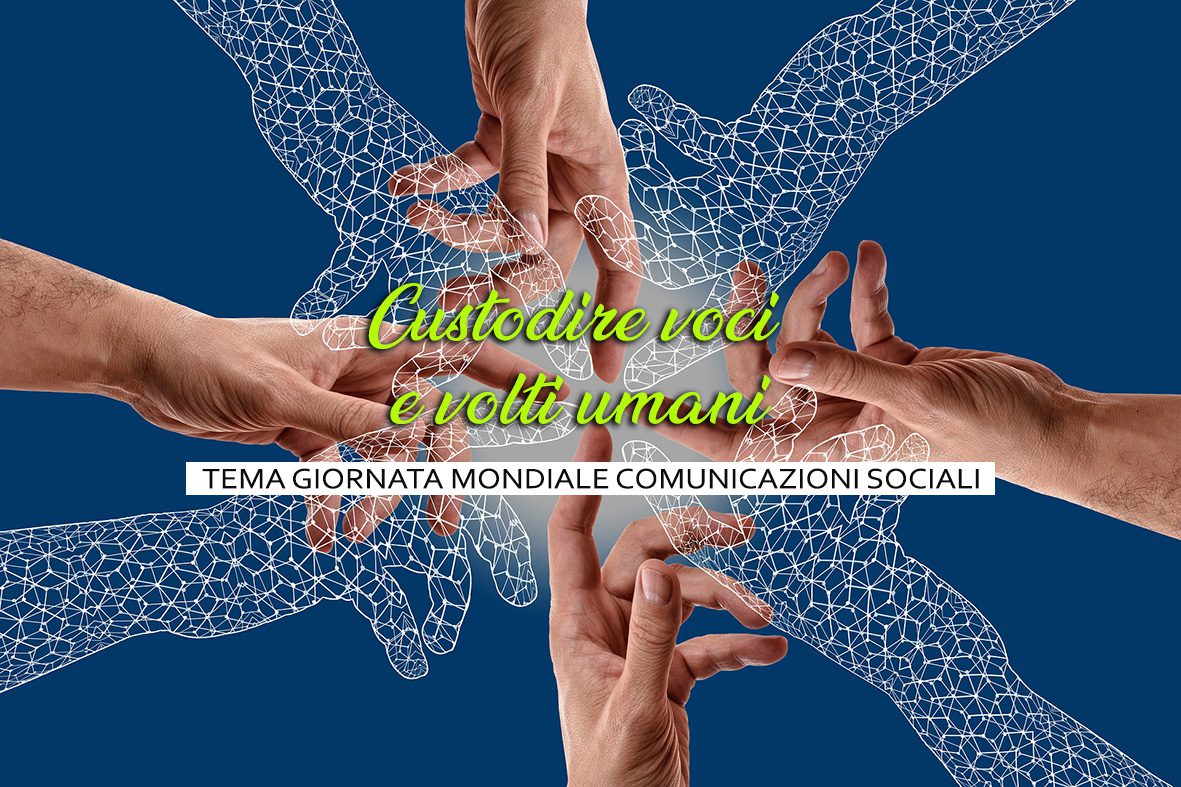
Rome (Italy). On 29 September 2025, the Vatican Press Office announced the theme chosen by Pope Leo XIV for the 60th World Day of Social Communications (WDSC) to be celebrated on 17 May 2026, Solemnity of the Ascension of the Lord:
Preserving human voice and faces
The theme of the Message – which will be read in its entirety on 24 January 2026, in the memory of Saint Francis de Sales, patron saint of journalists and communicators – is contextualized in today’s scenario, characterized by a great impact of technology that “In today’s communication ecosystems, technology influences interactions more than ever before – from algorithms curating news feeds to AI authoring entire texts and conversations.”
In the Statement from the Dicastery for Communication of the Holy See it is highlighted that, even if these tools offer the human race “possibilities unthinkable only a few years ago”, however, “they cannot replace the uniquely human capacities for empathy, ethics, and moral responsibility.”
Similarly, the communicative act is not reducible to one “data pattern”, but rather requires “human judgment”. And that poses a challenge:
“The challenge is to ensure that humanity remains the guiding agent. The future of communication must be one where machines serve as tools that connect and facilitate human lives, rather than erode the human voice.”
In the face of the great opportunities offered by the use of technologies, the statement warns of the “real” risks of artificial intelligence, of which some concrete effects – such as the manipulation of photographs, videos, and voices – are already on the agenda:
“AI can generate engaging but misleading, manipulative, and harmful information; replicate biases and stereotypes from its training data; and amplify disinformation through simulation of human voices and faces. It can also invade people’s privacy and intimacy without their consent.”
The aspect that perhaps causes the most concern, especially with respect to the new generations, is however linked to the dependence on these tools, which are certainly captivating for innovative interfaces and contents, but which on the other hand risk inhibiting critical thinking and creativity, as well as fueling dangerous social drifts:
“Overreliance on AI weakens critical thinking and creative skills, while monopolized control of these systems raises concerns about centralization of power and inequality.”
The advent, so sudden and integrated into daily life, of Artificial Intelligence, raises an educational urgency that is increasingly indispensable and non-demandable, especially in the Catholic context, in acquiring the skills necessary to accompany young people in becoming expert navigators not only of the network, but also and above all of life, without losing the ontological characteristic of the human:
It has become thus urgent to introduce Media Literacy in the educational systems, or even Media and Artificial Intelligence Literacy (MAIL). As Catholics we can and should give our contribution, so that people – especially youth – acquire the capacity of critical thinking, and grow in the freedom of the spirit.
Pope Leo XIV, since the beginning of his Pontificate, has shown himself attentive to the topic of Artificial Intelligence and its developments, in line with the same concern of his predecessor Pope Francis to cultivate a ‘wisdom of the heart’ that cannot be equaled by machines and an artificial intelligence, that remains at the service of the human, without replacing it:
AI, especially Generative AI, has opened new horizons on many different levels, including enhancing research in healthcare and scientific discovery, but also raises troubling questions on its possible repercussions on humanity’s openness to truth and beauty, on our distinctive ability to grasp and process reality. Acknowledging and respecting what is uniquely characteristic of the human person is essential to the discussion of any adequate ethical framework for the governance of AI. (Pope Leo XIV – Message to participants at the second annual conference on artificial intelligence, ethics and corporate governance).