


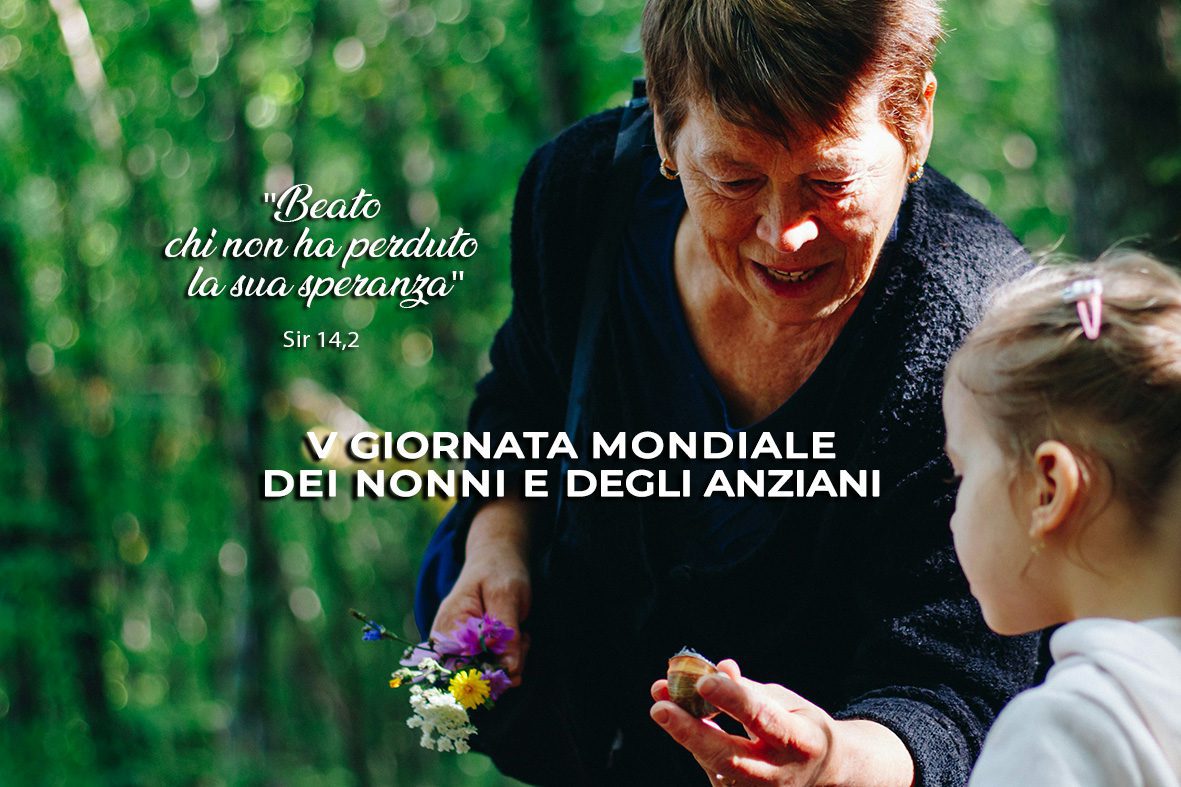
Rome (Italy). The 5th World Day of Grandparents and the Elderly is celebrated on 27 July 2025, desired by Pope Francis on the fourth Sunday of July each year, close to the anniversary of Saints Joachim and Anna, grandparents of Jesus.
Blessed the one who has not lost hope (cf. Sir 14:2) is the theme chosen by Pope Leo XIV, in the setting of the Jubilee year. “The Jubilee we are experiencing helps us to discover that hope is a source of joy always, at every age. When, then, it is tempered by the fire of a long existence, it becomes the source of full bliss,” explains the Holy Father.
There are several biblical references that appear in the Message – from Abraham and Sarah, to Zechariah and Elizabeth, to Moses, to Nicodemus with his question, to Jacob, all aimed at highlighting examples of people advanced in years as signs of hope and manifestations of God’s Providence. “With these choices, He teaches us that in His eyes, old age is a time of blessing and grace and that the elderly, for Him, are the first witnesses of hope.”
The biblical origins of the Jubilee also speak of a special time of liberation from oppression and inequalities and the restoration of the social order that God wanted. This is why Pope Leo launches an appeal. “Looking at older people from this Jubilee perspective, we too are called to experience liberation with them, especially from loneliness and abandonment.” And he thus invites us to consider it as a propitious time to “break down the walls of indifference, in which the elderly are often locked up. Our societies, at every latitude, are too often getting used to letting such an important and rich part of their companions to be kept on the margins and forgotten.”
He therefore calls for a “change of pace”, an assumption of responsibility by the whole Church:
“Every parish, every association, every ecclesial group is called to become the protagonist of the ‘revolution’ of gratitude and care, to be achieved by frequently visiting the elderly, creating support and prayer networks for them and with them, weaving relationships that can give hope and dignity to those who feel forgotten. Christian hope always pushes us to dare more, to think big, not to be satisfied with the status quo. In this case, to work for a change that restores esteem and affection to the elderly”.
Then recalling his predecessor who wanted the Day to be celebrated first of all by visiting those who are alone, he recalls the possibility for those who will not be able to come to Rome on pilgrimage to “obtain the Jubilee Indulgence if they go to visit the elderly for a suitable time in solitude, […] almost making a pilgrimage towards Christ present in them (see Mt 25: 34-36)” (Regulations on the Granting of Jubilee Indulgence, III). Visiting an elderly person is a way to meet Jesus, who frees us from indifference and loneliness.
Finally, he turns with affection to elderly people, often tried by discouragement or physical ordeals, encouraging them to pray, as Pope Francis taught during his last hospitalization. “Our body is weak but, even so, nothing can stop us from loving, praying, giving ourselves, being there for each other, in faith, luminous signs of hope.”(Angelus, 16 March 2025) Let us value the signs of vitality in the love that bring hope and comfort, like grandchildren who brighten up the days.
“Let us lovingly transmit the faith we have lived for so many years, in the family and in daily encounters. Let us always praise God for His benevolence, let us cultivate unity with our loved ones, let us broaden our hearts to those who are further away and, in particular, to those who live in need. We will be signs of hope, whatever our age.”