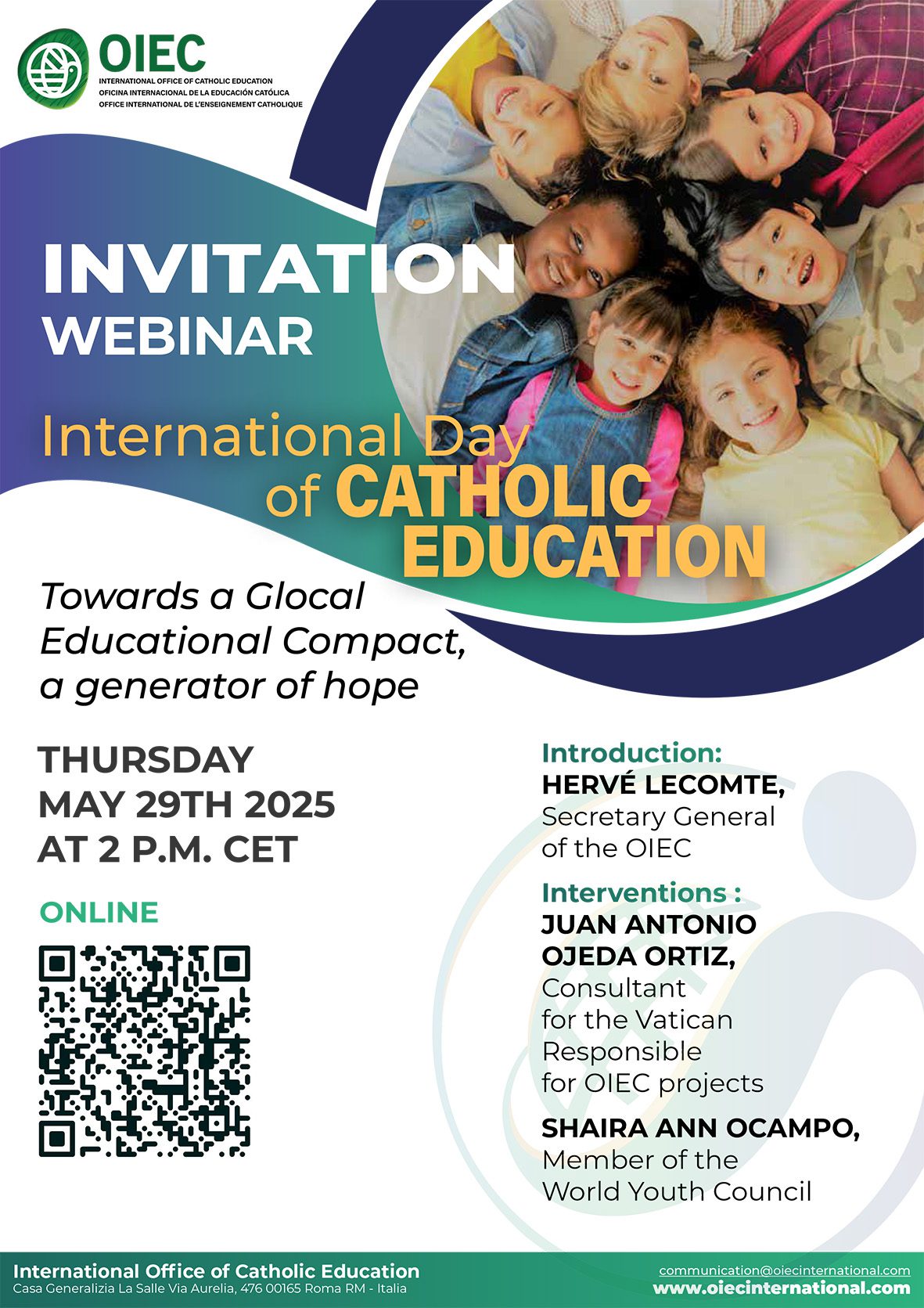

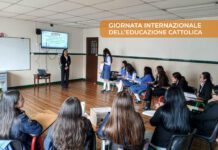
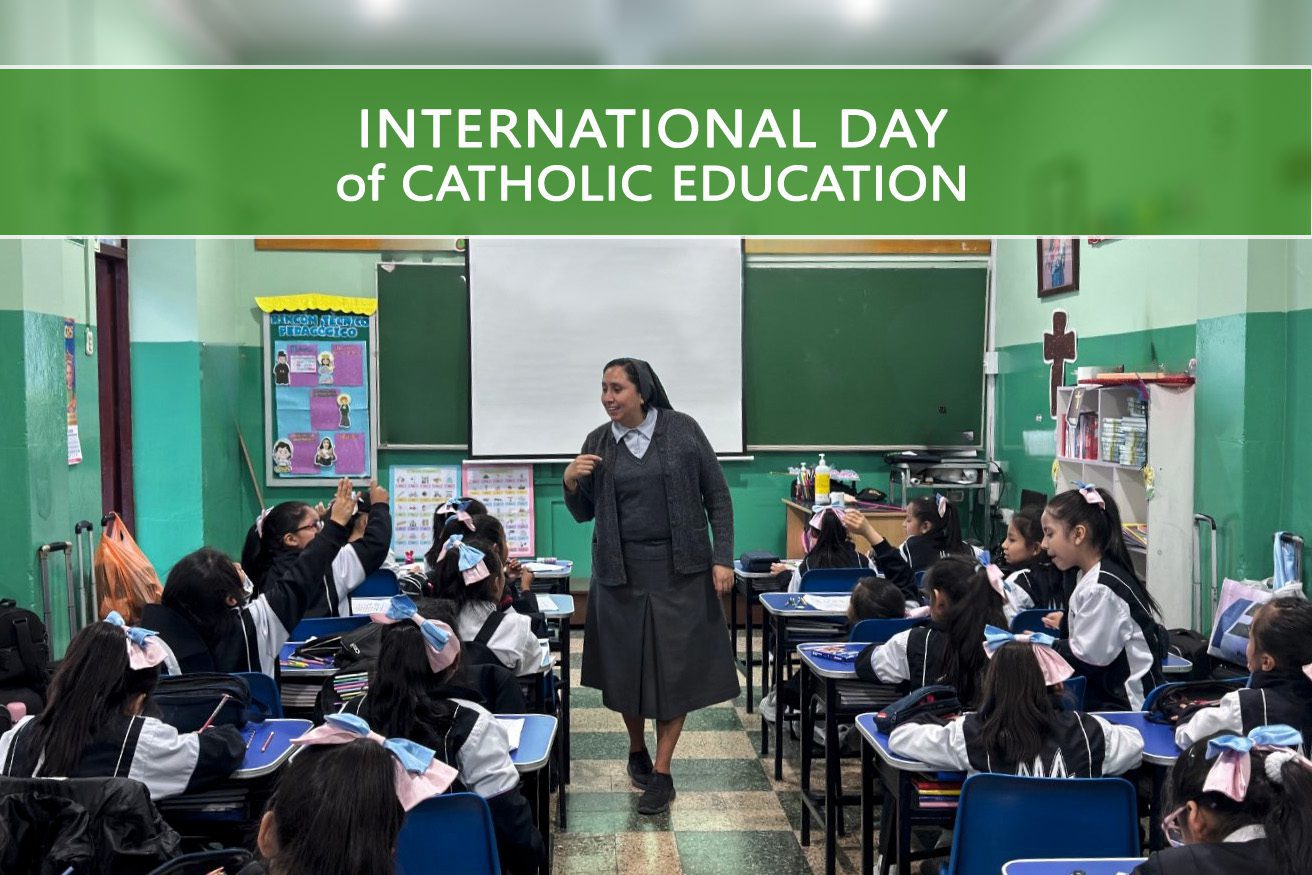
Rome (Italy). On 29 May 2025, 40 days after Easter, the 24th International Day of Catholic Education is celebrated, established in 2002 by the Congress of the OIEC (Office International de l’Enseignement Catholique) held in Brasilia, to draw attention to the contribution that educational institutions can make to global development and the promotion of a culture of peace and fraternity.
“Towards a glocale educative pact, generator of hope” is the theme of the webinar promoted by the OIEC, which will be held on 29 May, at which Juan Antonio Ojeda Ortiz, Consultant of the Department of Culture and Education, responsible for OIEC projects, and Shaira Ann Ocampo, Member of the Global Youth Council, who will be introduced by Hervé Lecomte, Secretary General of OIEC.
The event represents an opportunity to reflect on the fundamental role of Catholic education in building a better future, based on hope, solidarity, and a glocale vision of education. Catholic education is a space where future builders meet, committed to shaping a more just and fraternal society.
Educating is an act of Hope. In a rapidly changing world, education becomes the path through which challenges are transformed into opportunities, growing hope and preparing young people to become responsible adults. Hope and education walk together, opening horizons and renewing our gaze, even in the midst of the difficulties of the present.
The Institute of the Daughters of Mary Help of Christians, with its educative charism, from the beginning has had special care for the formation of educators. In the early years after its Foundation – late 19th and 20th century – numerous Normal Schools were opened, many of which are still active in different Countries, engaged in the formation of educators for children, adolescents, and young people.
Formation paths were then launched through the Faculties of the Science of Education, still operating in various Nations, where many Christian educators are being formed, engaged in an educative mission inspired by evangelical values. Today there are 42 Institutions of Higher Studies which, for a large part, are dedicated to the formation of educators.
Being an educator means being a “pilgrim in the world of education”, walking through challenges and successes, lights and shadows. As pilgrims, we are called to inhabit this space with an attitude of research and transformation, broadening the horizons for all towards a more human future in solidarity. Education, in fact, is not limited to the transmission of knowledge, but it is an act that challenges conventions and creates new possibilities, cultivating seeds of hope.
The true essence of the educative act lies in confidence in the potential of the other. It is a process that prepares for the future, encouraging talent to flourish, and building confidence in tomorrow. Thus, every educator becomes a witness of hope, carrying out a mission that believes in life, in the good, and in the possibility of change.
Every educative gesture thus becomes a sign of trust in humanity and the transforming power of learning. Educators are called to be living signs and witnesses of hope, both in the present and in building a more just and fraternal future. Every educative encounter, every challenge overcome, becomes a step towards a better world, a world that is born from the trust in the new generations.
Pope Leo XIV, speaking to the Brothers of the Christian Schools, on 15 May 2025, encouraging them to continue to keep alive attention towards the schools, the formation of teachers, and the realization of educating communities in which the didactic effort is enriched by the contribution of all, and he left some questions:
“What are the most urgent challenges to be faced in today’s youth world? What values should be promoted? What resources can we count on?
The young people of our time, like those of every epoch, are a volcano of life, energies, feelings, and ideas. You can see it in the wonderful things they do, in so many fields. But they also need help to grow in harmony with all this wealth and to overcome what, although differently than in the past, can still prevent their healthy development.”