








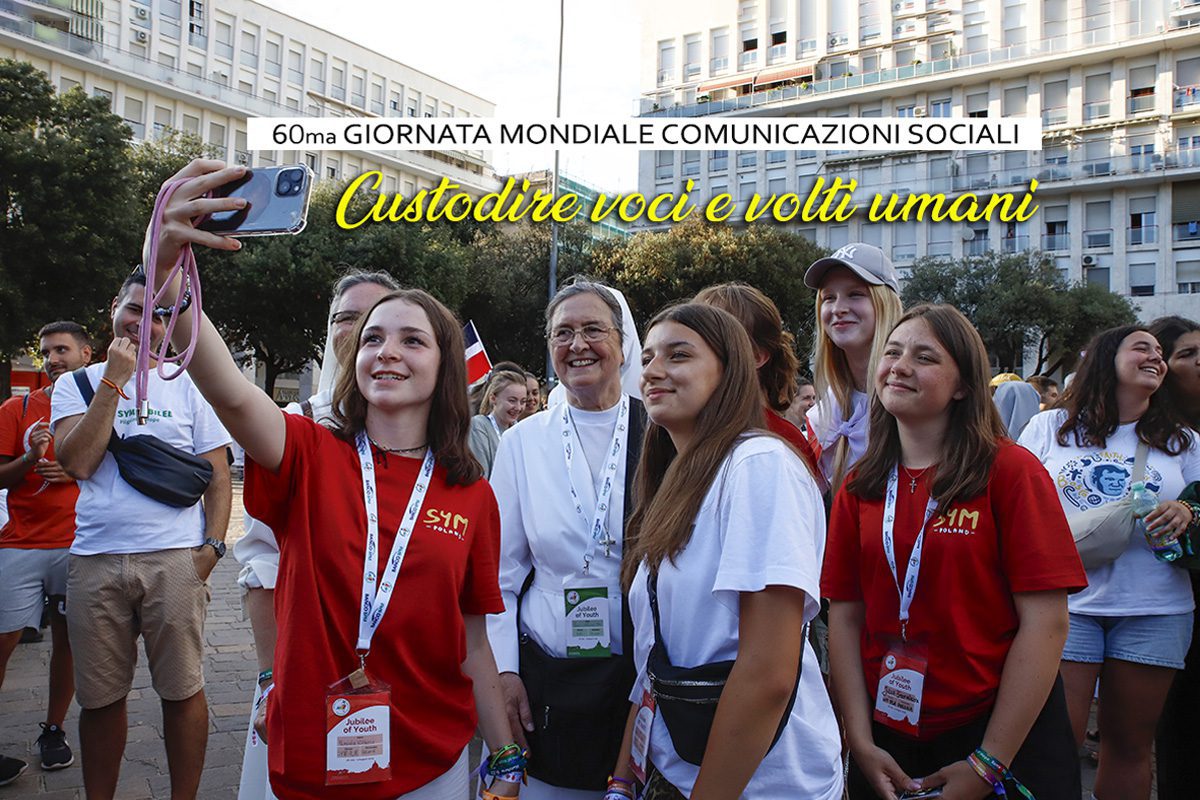
Rome (Italy). On 24 January2026, in the liturgical memorial of St. Francis de Sales, patron saint of journalists and communicators, the Message for the LX World Communications Day (WCD), celebrated in May, is published on the theme:
Preserving human voices and faces
The Holy Father opens his first Message for this Day by specifying that, “The face and voice are unique, distinctive traits of each person; they manifest their unrepeatable identity and are the constituent element of every encounter.” This statement is accompanied with references to the etymology of words and Greek culture.
“Face and voice are sacred. They were given to us by God who created us in His image and likeness.” An existence to which man and woman were called through the Word, by which God finally communicated Himself to humanity through the Voice and Face of Jesus, Son of God.
As Saint Gregory of Nyssa expresses it, humans have been impressed with a royal character, since from creation God wanted them as His interlocutor and imprinted on their face a reflection of divine love:
“To guard human faces and voices therefore means to guard this seal, this indelible reflection of God’s love. We are not a kind of biochemical algorithms, defined in advance. Each of us has an irreplaceable and inimitable vocation that emerges from life and which manifests itself precisely in communication with others.”
This is the heart of Pope Leo’s Message, the key to understanding that helps us grasp the challenge of new technologies, a challenge that is primarily anthropological: “To preserve faces and voices ultimately means to preserve ourselves.”
The Message continues with a good analysis of many now daily situations pervaded by the use of Artificial Intelligence “as an ‘omniscient friend’, dispenser of all information, archive of all memory, ‘oracle’ of all advice,” and of the risk that, by avoiding the effort of one’s own thought and contenting oneself with an artificial statistical compilation, one ends up in the long run with “eroding our cognitive, emotional, and communicative abilities.”
It is therefore, not a question of the potential of these machines to serve humanity, but rather of growing in humanity and knowledge, with a wise use of these tools. On the other hand, “Giving up the creative process and giving up one’s mental functions and imagination to machines means burying the talents we have received in order to grow as people in relation to God and others. It means hiding our face, and silencing our voice.”
The Pope does not overlook the social implications of technology, which often, through its antopomorphization, deceives the most vulnerable people in particular, which exploits the need for relationships and which “cannot only have painful consequences on the fate of individuals, but can also damage the social, cultural, and political fabric of societies.”
By replacing relationships with AI, building a world “in one’s own image and likeness”, in reality “we allow ourselves to be robbed of the possibility of meeting the other, who is always different from us, and with whom we can and must learn to deal. Without the acceptance of otherness there can be neither relationship nor friendship.”
The Holy Father therefore warns of the risk of giving in to the power of AI simulation, which deludes with the fabrication of parallel “realities”, “appropriating our faces and our voices.”
There is therefore a risk of no longer distinguishing between reality and fiction, with knowledge provided by systems such as “approximations to the truth”, sometimes “real hallucinations”. In journalism, when we rely on these systems and lack “on-the-ground” verification of sources, we foster “even more fertile ground for disinformation, causing a growing sense of mistrust, bewilderment, and insecurity.”
A possible alliance
In the final part of the Message, Pope Leo, while expressing concern about an “oligopolistic control of algorithmic and artificial intelligence systems capable of subtly orienting behavior, and even rewriting human history – including the history of the Church – often without our realizing it,” speaks of a “possible alliance”.
And of a challenge, which “is not in stopping digital innovation, but in guiding it, in being aware of its ambivalent character.” That same voice, which is in the title of the Message, must then be raised “in defense of the human person, so that these tools can truly be integrated by us as allies.”
He identifies three pillars to lay the foundations for this alliance:
– above all, the responsibility “in the face of the future we are building,” which “no one can escape”, both those at the top – creators and developers of AI models, national legislators, and supranational regulators, media companies – who have the duty of transparency, professionalism, to monitor respect for human dignity.
– Cooperation: all called to cooperate in building and making effective a conscious and responsible digital citizenship. “No industry alone can address the challenge of driving digital innovation and AI governance. It is therefore necessary to create safeguard mechanisms.”
– Education which aims to “increase our personal capacities to reflect critically, to evaluate the reliability of sources and the possible interests behind the selection of information that reaches us, to understand the psychological mechanisms they activate, to allow our families, communities and associations to develop practical criteria for a healthier and more responsible culture of communication.”
In this regard, Pope Leo considers it increasingly urgent “to introduce media, information, and AI literacy into education systems at every level as well.” Literacy that must reach even the elderly and the most marginalized members of society, with lifelong education initiatives.
These are paths that will be able to help everyone – says the Pope – “not to adapt to the anthropomorphizing drift of these systems, but to treat them as tools.”
The Message ends with the hope that we will return to the original nucleus of the person, according to its unique and unrepeatable etymology. “We need the face and the voice to return to say the person. We need to guard the gift of communication as humanity’s deepest truth, to which every technological innovation can also be directed.”