






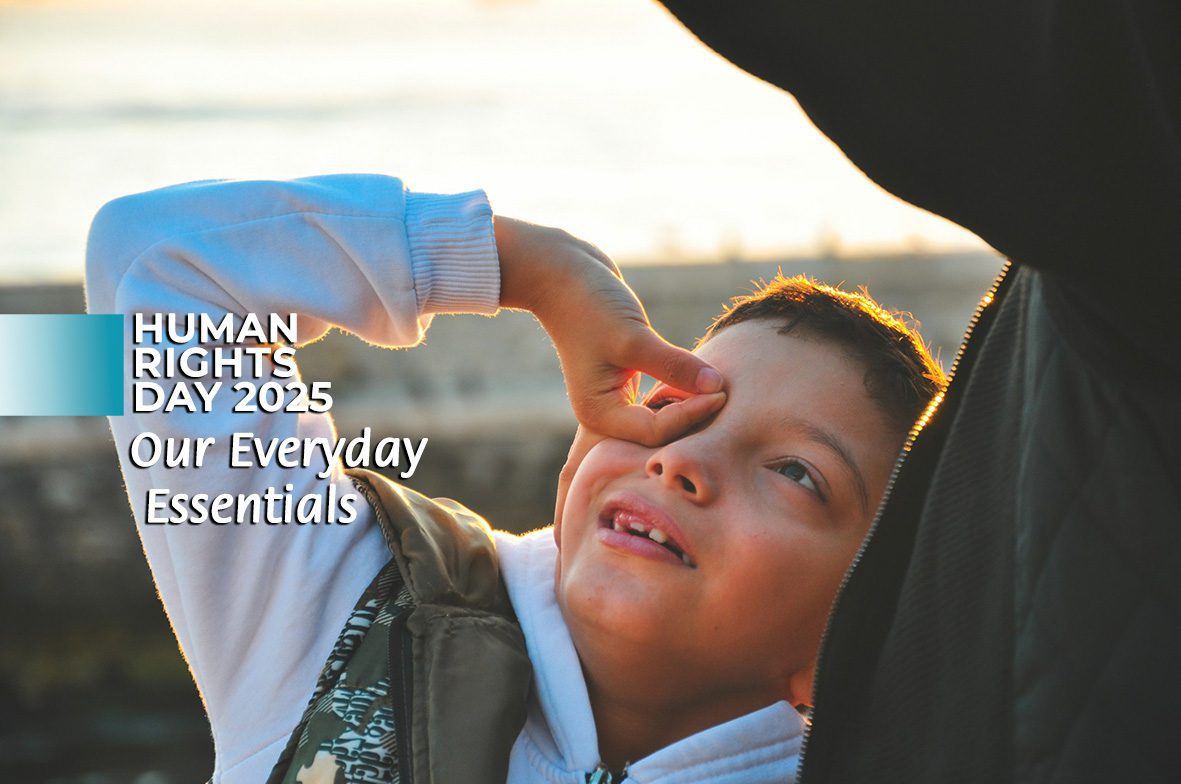
Geneva (Switzerland). World Human Rights Day is celebrated on 10 December 2025, to commemorate the day the United Nations General Assembly adopted the Universal Declaration of Human Rights (UDHR) in 1948.
The theme of the Day – Human Rights: our Everyday Essentials – underlines precisely the timeless importance of the Universal Declaration and its fundamental values: equality, justice, freedom, and dignity.
These essential elements of daily life, as the United Nations document highlights, “are enshrined in the UDHR: the right to an adequate standard of living (Article 25), which guarantees food, basic necessities, and a healthy environment; the right to freedom of opinion and expression (Article 19), which ensures access to information; the right to education (Article 26), which allows for understanding and informed decisions; and the right to rest and leisure (Article 24), which allows time to be dedicated to well-being and relationships with others. However, these simple rights are not guaranteed everywhere.
“Our Everyday Essentials” Campaign
The United Nations campaign aims to promote understanding of human rights and build confidence in their relevance. It aims to involve the “silent majority”, that is, those who believe in human rights but do not yet consider themselves their supporters. The aim is to raise public awareness and encourage meaningful and responsible collective engagement. The campaign calls for rediscovering that human rights are positive, essential, and attainable.
- They are positive because they protect. They allow living in joy, freedom, and solidarity. They allow the experience of security and peace. They are an integral part of the safety on which one relies; air to breathe, a clean environment, food to eat, words to speak and choices to make.
- They are essential because they form the common ground that unites people beyond differences in race, culture, gender, creed, or origin. When the world appears insecure and unstable, the right to express oneself freely, to participate in decision-making processes, and to live without fear becomes the firm anchor that holds societies together.
- They are attainable because they start with each one, with the many small choices and daily actions. As Eleanor Roosevelt said 80 years ago: “Where do universal human rights begin, after all? In small places, close to home, so close and so small that they cannot be seen on any map of the world. Yet they are the world of the individual person; the neighborhood where one lives; the school or university one attends; the factory, farm, or office where one works. These are the places where every man, woman, and child seeks justice, equal opportunities, and dignity without discrimination. If these rights have no meaning there, they have little meaning everywhere. Without concerted action by citizens to defend them close to home, we will search in vain for progress in the wider world.”
The Office of the United Nations High Commission for Human Rights (UN HCHR) invites everyone to share what matters most in their daily lives, that is, what is considered essential in everyday life. You can access the various participation channels via the online form or on social media using the hashtag #OurEverydayRights. Together, these personal experiences will form a rich mosaic of voices and perspectives
The Institute of the Daughters of Mary Help of Christians, also through the UIIMA Human Rights Office IIMA and VIDES International, continues to work to network with governments, non-governmental organizations, and civil society actors, to raise awareness of human rights values and empower young people around the world through education and human rights education, so that every person can fully enjoy his or her rights as an essential part of everyday life.