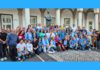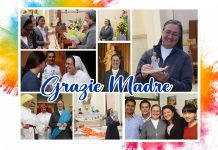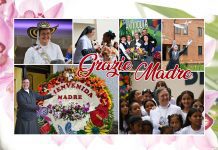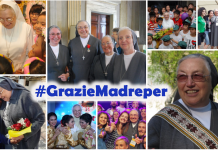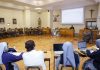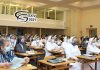

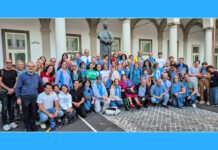
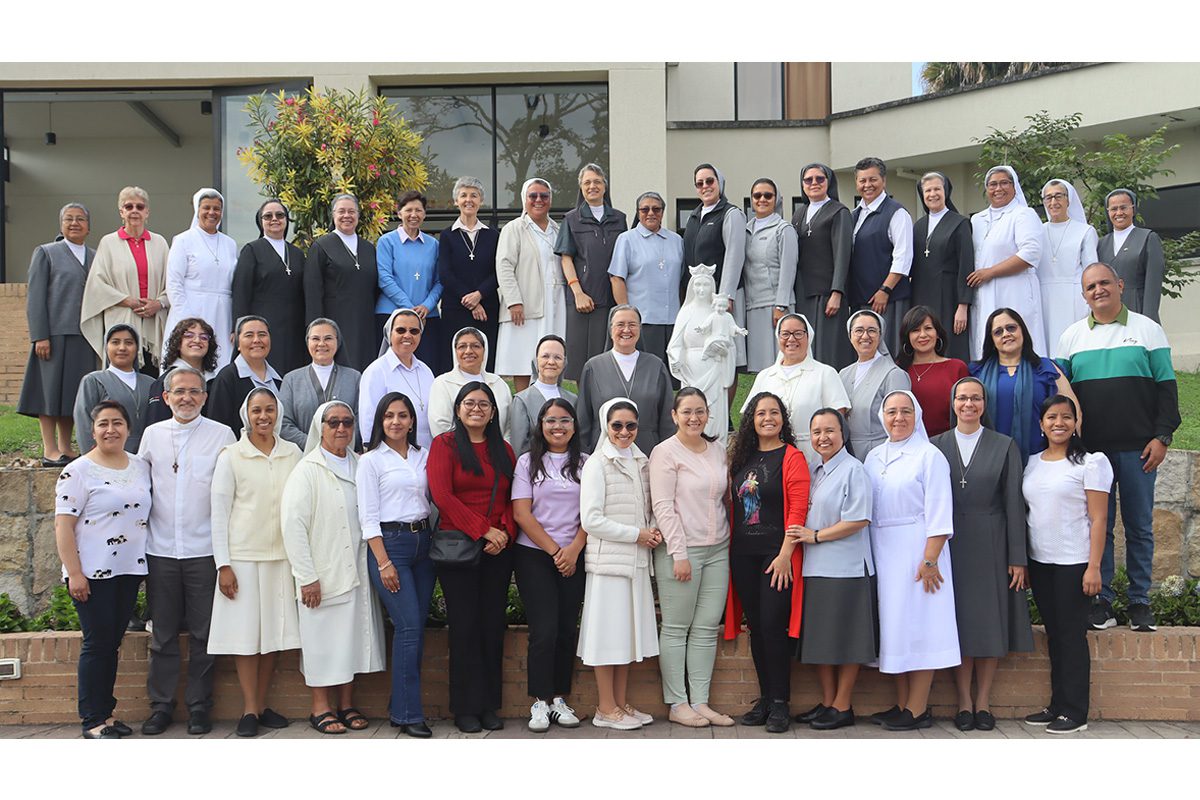
Bogotá (Colombia). From 17 to 23 August 2025, at Casa Villa María in Fusagasugá, the Triennial Verifica of the Interprovincial Conference of Bolivarian Nations (CINAB) took place, with the participation of 44 people, including the Superior General of the Institute of the Daughters of Mary Help of Christians, Mother Chiara Cazzuola, and some General Councilors: Sister María del Rosario García Ribas, Sister Nilza Fátima de Moraes, Sister Leslie Sándigo Ortega, Sister Maria Ausilia De Siena, Sister Ena Veralis Bolaños, Sister Ruth del Pilar Mora, and Sister Marta Liliana Riccioli, Referent of the Conference.
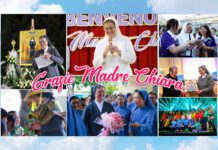
The experience has the aim of discussing together the processes proposed in General Chapter XXIV, already started in the interprovincial conferences, in the Provinces, and in the communities, to reread them in the light of the Word of God and the challenges of the contemporary world, projecting itself with renewed hope towards the future. It was also an opportunity to thank Mother Chiara for her 50 years of consecrated life.
The beginning of this moment of Kairos was August 17th with a parade of flags, typical dances of the country, performances by the Aspirants, and a song dedicated to Sister Maria Troncatti. After the words of welcome from Sister Angelica Medina, Provincial of Our Lady of the Rosary of Chiquinquirá Province (CBC), the different delegations presented themselves creatively.
On 18 August, Lauds is followed by the Eucharist presided over by Archbishop Luis José Rueda Aparicio, Archbishop of Bogotá and Primate of Colombia. He shared a reflection focused on three words – heart, family, and water – with the invitation to live the Gospel starting from the essential. Subsequently, Father Luis Vivó of the Verbum Dei Missionary Fraternity community, held the lectio divina on the Wedding at Cana, urging us to put ourselves in the role of Mary, a woman of prayer, listening, and intercession, and to strengthen relationships of closeness and trust.
Sister María Eugenia Ramos, President of CINAB, welcomed all the participants, announcing that during the Verifica, a summary of the journey of the eight CINAB Provinces would be proposed. Sister Marta Riccioli thanked her for the preparatory work carried out by the various commissions and reminded that participating in the Verifica is a gift and a commitment, as well as a responsibility.
Over the days, Mother Chiara highlighted the importance of this moment of discussion and community contemplative reading in the light of the Word of God and the challenges of contemporaneity. In her first presentation, she spoke of “Pilgrim Communities of Hope,” echoing the words of Pope Leo XIV during his first General Audience, when he used the image of Van Gogh’s painting, “The Sower at Sunset” to reinforce the message of hope and trust in God’s mysterious work. Mother affirmed that on the journey traveled, she too experienced the fatigue of sowing, but the Lord makes the commitment bear fruit. She invited listening and discernment in the light of the Word and history.
In the second presentation – “Synodality and the educating community” – she took up the words of Pope Francis and underlined how synodality is not just a question of structures, but a fundamental vision of how the Church should be in the modern world. The Church is a “People of God” and all the baptized have a role to play in the life of the Church. Synodality allows the voices of those who are often marginalized or ignored to be heard and considered in decision-making.
Developing the theme, “Called to rekindle the fire of the missionary spirit,” she stated that the missionary spirit must animate everyone, without locking ourselves into our own small group or feel superior. One is called to offer the love of God to everyone, to achieve a unity that does not cancel out differences, but enhances the personal history of each one and the social and religious culture of each people. In the 150th of the 1st missionary expedition, she recalled that Don Bosco and Mother Mazzarello wanted the FMA to burn with missionary fire and be willing to leave for distant and unknown lands. The first form of evangelization is to be a sign and expression of God’s love.
In the fourth intervention, Mother addressed “Integral ecology and the spirituality of care”. She questioned the assembly by asking, “Are we forming sensitive people, critical minds and consciences, hearts grateful for the gift of creation, of which we are part?” Education is called formation for an “ecological citizenship”, but this will only be achieved starting from the gift of oneself in constant commitment. Don Bosco and Mother Mazzarello expressed their care for the integral education of children and young people, using the language and tools of the time.
In her last intervention, Mother spoke of “A future of the Charism starting from a look at the origins and thinking about the future starting from the present.” She affirmed forcefully, “We need ‘broad visions’, a solid culture, wisdom, critical and purposeful sense that opens up horizons and fuels possible dreams and of the future. We are aware that the coherence and strength of testimony are necessary to be effective and fruitful in the good.”
The working methodology in the different groups was based on conversation in the Spirit, creating an atmosphere of trust and welcome, to express oneself with greater freedom, making oneself more aware of the presence and participation of the Holy Spirit in the process of sharing and discernment.
Another significant contribution was the conference of Sister Gloria Liliana Franco, a Religious of the Company of Mary. She invited us to always have an attitude of hope, of discernment, to seek what God wants from each one, to seek new relational ways, to live as missionaries, to inhabit reality, to recognize the call, and to be sentinels of hope. She also encouraged discovering God in the community, in young people, in the poor.
The General Councilors instead shared the progress in the work carried out and requested by GC XXIV, starting from the updating of the Formation Plan and the Guidelines of the Educational Mission, by Sister Nilza, Councilor for Formation. The Vicar, Sister María del Rosario, spoke about updating the protocols for the protection of minors and vulnerable adults, developed together with experts.
The “Goodnight” moments were formative spaces in which it was shared how the Chapter deliberation is implemented in the Communities. Sister Celmira Serna, Provincial of Mary Help of Christians Province (CMA), shared the ecological-Laudato si’ project carried out by the students of Saint Martha Normal Schools. Sister Gabriela Vivero Herrero, Provincial of Our Lady of Peace Province (BOL), shared the project, “It’s everyone’s job”. Sister Ausilia De Siena, Councilor for Communication, shared the resources of Sister Maria Troncatti’s website. Mother spoke of “generating life and holiness” and presented this virtue experienced in the Institute, as well as showing a video on Sister Maria Troncatti. She also presented the Institute’s statistics.
On the fourth day, during the Goodnight, Mother spoke about Mary Queen, whose memory was celebrated on August 22. She recommended asking Her for the gift of peace for all peoples and of educating children and young people to live the value of forgiveness. For this reason, it is necessary to take care of language and expressions, to experience the ecology of the heart. Pope Leo XIV said that, as educators, one has a great responsibility to care for and defend peace.
To conclude, Mother and the Councilors thanked the CINAB Provincials for their responsibility in preparing and carrying out the Verifica. On the last day of the meeting, the Eucharist of thanksgiving for this time of grace and relaunch on the journey was celebrated, presided over by Fr. Rubén Dario Jaramillo, SDB, Superior of St. Peter Claver Province (COB). The evening ended in Salesian style, with a cheerful and lively Salesian recreation.
For the eight Provinces that make up the CINAB Conference, preparing this meeting was a synodal work, a great wealth fueled by the reflection carried out in the Educating Communities with the participation of sisters, lay people, and young people.
Photos: Flickr FMA