






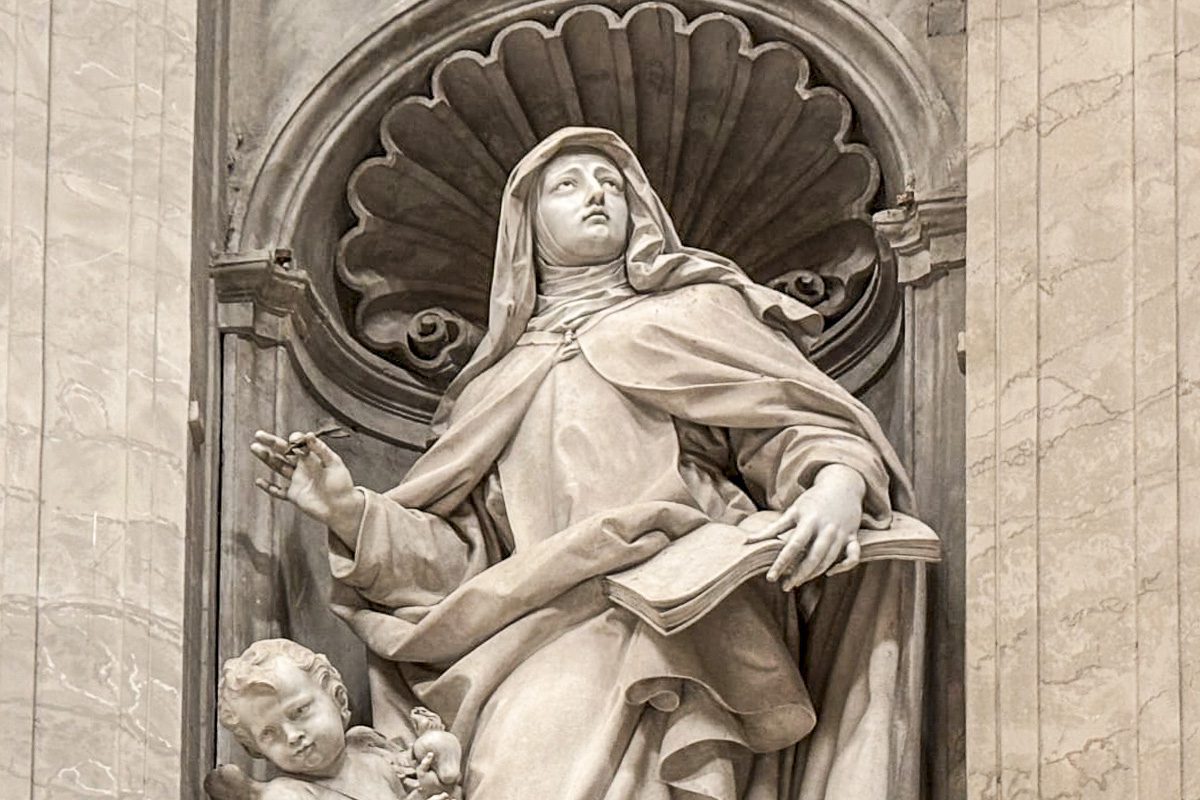
Rome (Italy). On 15 October 2024, the Church celebrates Saint Teresa of Avila (1515 – 1582), a Carmelite nun whose experiences and teachings have been recognized by the Church through Saint Paul VI who, in 1970, proclaimed her, the first woman in history, Doctor of the Church. Saint Teresa lived a unique experience of prayer that renewed her whole life in a unified dynamic of action and contemplation.
Don Bosco wanted her to be the patron of the Institute of the Daughters of Mary Help of Christians precisely because of this unique ability to combine prayer and activity in a harmonious synthesis founded on love. Teresa’s doctrine, founded on experience and personal search, has guided generations of believers who have found in her a teacher of spiritual life.
For Teresa, the essential means for the “Path of perfection” is meditation. She writes, “I am convinced that if, with the grace of God, the beginner strives to reach the summit of perfection, she will enter heaven not alone but by taking with her many people, as a good captain whom God has entrusted with a strong army.” (Book of Life 11,4)
For her, “the meditation on self-knowledge should never be left out” (Book of Life 13, 15) as the ultimate goal is the configuration to Christ. It is a metamorphosis that compares to the one of the caterpillars into butterflies. “Now we see how this little worm transforms, which is the purpose of everything I have said. When in this prayer, dead to all things of the world, it changes into a white butterfly.” (Interior Castle V 2,7)
“In fact, for me, living is Christ and dying is gain. Likewise, I think the soul, because it is here where the butterfly is, of which we have spoken, dies, and with extreme joy, since now Christ is its life.” (Interior Castle VII 2,5)
For Saint Teresa, meditation is not a private fact, which produces relevant effects on the lives of those who are somehow entrusted to him/her who even only begins to practice it. In the Way of Perfection, she states that before speaking about prayer, she will say some “things so necessary that with them, without being contemplative spirits, one can progress a lot in the service of the Lord, while if you do not possess them, it is impossible to be great contemplative souls.”
And she continues, “I will limit myself to three things inherent in the Constitutions themselves, being very important to understand the strict obligation of observing them for the internal and external peace that the Lord has so recommended to us: the first is mutual love; the second, detachment from all creatures; the third, true humility which, although I name myself the last, is the main virtue and embraces them all.” (Way of Perfection 4,4)
Prayer is prepared with life; life is sanctified by prayer in a virtuous circle that tends to absorb all the dimensions of the person’s life.
Saint Teresa is of disarming actuality, as a great knower of the human soul and therefore does not hesitate to warn, “I highly recommend never leaving out prayer, because with it we know our state, repent of the offense made to God, and gain strength to rise again. Yes, yes, believe me; whoever moves away from prayer is in very grave danger.” (Book of Life 15,3).
On the contrary, who perseveres in the path of prayer and meditation, strengthens and develops their own talents to express the creativity and audacity of charity. “This is the aim of prayer, my daughters; for this purpose, spiritual marriage always helps to bring forth new works.” (Interior Castle VII 4,6)
From Saint Mary Mazzarello to Mother Chiara Cazzuola, the Superiors General of the Institute of the Daughters of Mary Help of Christians have dedicated one or more Circulars to recommend meditation.
Mother Antonia Colombo, for example, repeatedly addresses the theme, saying, “I am convinced that most of the difficulties we encounter in our relationships and which sometimes make it problematic to weave unity in diversity arise from the superficiality and dispersion resulting from the reduced ability to live in silence. This is fundamental in the existence of any creature that wants to grow in order, unifying itself around the core of its choices. All the more for the believer in Christ, called to come into contact with the Word that comes out of the silence of the Father, to keep it in her heart, to confront every event with it.” (Circ. no. 800, 24 April 1998).
Circular No. 816 of 24 December 1999, recalls the presentation of Theresa Ee-Chooi to the Interreligious Assembly held in Vatican City in October 1999: “The approach she presented involves, first of all, a change in ourselves because when we change, we also urge change in others. It consists in the use of a tool that most religions possess and which gives people the ability to choose the good, to create bonds of unity in mutual respect. It is meditation and the consequent practice of conscious attention, accompanied by the art of listening.”
In essence, the art of meditation is an indispensable condition for inner transformation and therefore for any real change in the community and society, but it is also ground for sharing and dialogue between religions and cultures, so necessary for peace.



Muy bella reflexión, valiosa. Muchas gracias!
Amei este texto. Muito enriquecedora esta reflexão. Além de crescimento pessoal, está ótimo para partilharmos com os Grupos da Família Salesiana pois todos e todas, precisamos crescer na dimensão da Oração e da Meditação! Podemos apreender muito com Santa Teresa e nossas superioras e irmãs no cotidiano. Louvemos a Deus pela espiritualidade viva em nosso Instituto. GRATIDÃO! Ir. Maria de Nazaré, fma/BMM
Grazie per questo approfondimento molto gradito!
Thank you for such a meaningful reflection on Meditation. May we spend quality time with God in Meditation.
Thanks for this comment on St. Thérèse of Avila and the awareness raised o the need of prayer and meditation.
Un bellissimo articolo! Grazie per questa riflessione.
Sr. Luigina Ariu